
…AND A FEW WORDS ABOUT MONSTER: THE LIZZIE BORDEN STORY
by Michael McCarthy
SPOILER WARNING: This review discusses major developments in UNABOMBER, particularly involving the young Ted Kaczynski and Henry Murray storyline. If you haven’t seen the film yet and want to go in knowing as little as possible, you may want to watch it before reading further. The review also contains mild spoilers about Monster: The Lizzie Borden Story.
###
Netflix’s new movie UNABOMBER does something I wasn’t expecting it to do: it makes you root for Ted Kaczynski. Not the Unabomber, exactly. You certainly aren’t rooting for him when he’s mailing bombs to people. But you do find yourself rooting for the brilliant, socially awkward 16-year-old Ted Kaczynski who arrives at Harvard and becomes involved in a series of psychological experiments conducted by Professor Henry Murray. And then the movie makes you feel shitty about it.
Jacob Tremblay plays the young Kaczynski, and he’s absolutely brilliant. I’d be surprised if he doesn’t receive some awards attention for the performance. Russell Crowe plays the initially sympathetic and later diabolical Murray perfectly while Shailene Woodley is compelling as Joanne Miller, an FBI agent involved in the investigation that eventually leads authorities to Kaczynski.
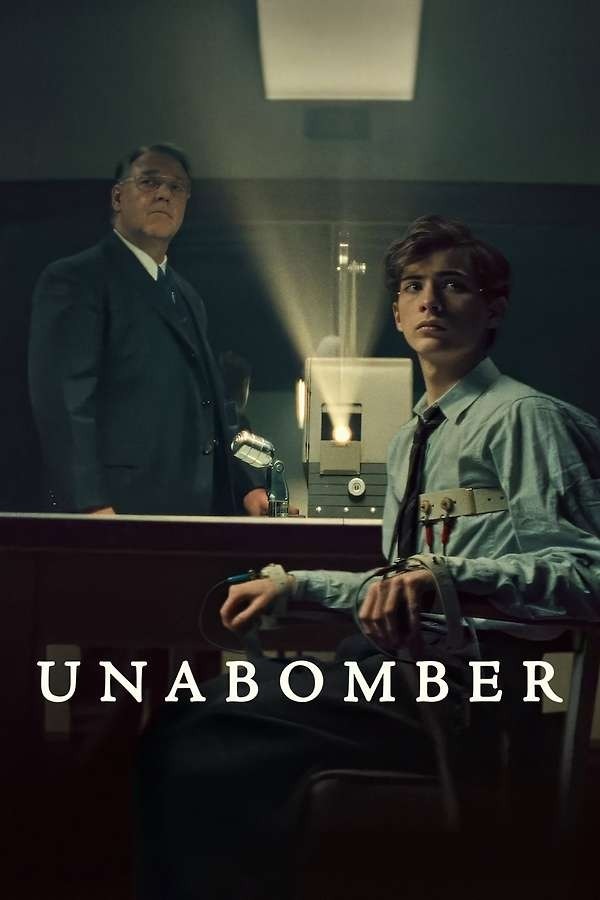
The movie jumps back and forth between those two periods. In one, we watch young Ted at Harvard, where he believes he’s participating in experiments involving intellectual debate. Instead, Murray and his researchers subject him to increasingly cruel psychological attacks, ridiculing his beliefs and exploiting his vulnerabilities, the study apparently funded by the CIA. The goal of the experiments is to prove that everyone has a breaking point at which they will become submissive. At first, Ted submits every time. But, eventually, he turns the tables on them and stops submitting, which ruins Murray’s entire study because he can no longer argue that everyone has a breaking point that can’t be overcome.
Tremblay’s performance makes Ted so painfully human during the experiment scenes that you can’t help feeling sorry for him. And once Ted begins figuring out what Murray is actually doing, you want him to fight back. You want him to beat Murray at his own game. Then UNABOMBER jumps forward several decades and reminds you exactly who you’re cheering for. That’s where the movie gets really interesting.
Watching UNABOMBER, I kept thinking about Netflix’s recent Monster: The Lizzie Borden Story. Both productions take notorious historical figures and use fictionalized material to encourage us to sympathize with them. But they go about it in very different ways.
Lizzie Borden gives you permission to root for Lizzie almost wholeheartedly. The series portrays the people around her, particularly her parents, as so monstrous that I found myself firmly on her side. Yes, I knew that the real Lizzie Borden was accused of murdering her father and stepmother (and was ultimately acquitted). But within the story Netflix was telling, I never felt particularly guilty about rooting for her.
UNABOMBER doesn’t let you off that easily. One minute you’re watching young Ted being humiliated and psychologically tormented, thinking, Come on, Ted. Figure this out. Don’t let these people break you. Then you’re back in the future, where innocent people are being killed and horribly injured by bombs sent by the man that kid eventually became. Suddenly you’re thinking: Wait a minute. I’m rooting for Ted fucking Kaczynski. I think that’s entirely intentional.
In a way, director Janus Metz and screenwriters Sam Chalsen and Nelson Greaves are deliberately trying to fuck with your head. They make young Ted sympathetic enough that you want him to triumph over Murray while simultaneously refusing to let you forget the monster he’ll eventually become. You want young Ted to win and adult Ted to be caught. It’s a deeply uncomfortable contradiction, and it’s one of the things that makes UNABOMBER so compelling.
Tremblay deserves a tremendous amount of credit for making it work. He doesn’t play young Ted like a budding supervillain. He plays him as an awkward, lonely and extraordinarily intelligent teenager who has been thrown into an adult world he’s emotionally unprepared to navigate. That makes his eventual transformation all the more disturbing.
Crowe is equally effective because Murray becomes something close to the villain of the Harvard half of the movie. He’s charismatic and intellectually imposing, but there’s also something deeply sinister about him. The confrontations between Crowe and Tremblay are among the movie’s strongest scenes.
Meanwhile, the FBI storyline gives the film the momentum of a thriller. Even though we already know how the story ends, there’s considerable suspense in watching investigators gradually close in on Kaczynski. Cutting between the investigation and Ted’s years at Harvard also prevents the movie from becoming either a straightforward police procedural or a conventional psychological biography.
There’s just one rather large complication: quite a bit of what we’re watching didn’t happen the way the movie presents it. Kaczynski really did enter Harvard at 16, and he really did participate in psychological experiments conducted by Murray. The Unabomber investigation, the publication of Kaczynski’s manifesto, his brother’s role in identifying similarities between Ted’s writings and that manifesto, and his eventual capture are also grounded in real events. But the elaborate psychological battle between Ted and Murray is largely dramatic invention. The filmmakers themselves acknowledge that there is no evidence Kaczynski had the specific relationship with Murray depicted in the movie. That’s important because the fictionalized material is also responsible for much of our sympathy for young Ted.
The movie constructs a remarkably persuasive narrative: here is a brilliant but vulnerable teenager who is psychologically abused by powerful adults, becomes increasingly alienated from society and eventually turns that alienation into violence. It’s dramatically satisfying. Real life isn’t nearly that tidy.
The movie goes so far as to have Murray diagnose young Ted with schizophrenia during their climactic confrontation. Kaczynski actually was provisionally diagnosed with paranoid schizophrenia decades later after his arrest, but Murray wasn’t the person who diagnosed him at Harvard.
Likewise, Shailene Woodley’s Joanne Miller isn’t a real FBI agent. She’s a fictional character through whom the movie dramatizes the enormous investigation that ultimately captured Kaczynski. The filmmakers have said that the FBI storyline incorporates things that really occurred during the investigation, but assigns them to fictionalized characters. None of that necessarily bothers me in itself. UNABOMBER is a dramatic movie, not a documentary, and movies based on true stories have always condensed events, combined characters and invented dialogue. What interests me is what those inventions accomplish.
With Monster: The Lizzie Borden Story, fictionalization makes Lizzie someone the audience can enthusiastically root for. With UNABOMBER, fictionalization makes young Ted someone we instinctively want to protect but then the movie uses the historical reality of what he eventually did to make us uncomfortable about having felt that sympathy in the first place. That’s a much more complicated emotional trick. And perhaps that’s why I found UNABOMBER so effective. It would have been easy to make Ted Kaczynski into a two-dimensional monster. We already know that he murdered three people and injured many others during a bombing campaign that lasted nearly two decades. There’s no suspense concerning whether he becomes a killer.
Instead, UNABOMBER asks a much more uncomfortable question: What happens when we look at the human being who existed before the monster? It doesn’t excuse what Kaczynski eventually did. In fact, the constant movement between the sympathetic teenager and the murderous adult makes excusing him almost impossible. But it does make you sympathize with him. And then it makes you feel terrible about it. That’s a pretty impressive thing for a movie to pull off.
Finally, I do have to say that I really enjoyed Monster: The Lizzie Borden Story. I’m not sure what to make of the fact that they played fast and loose with so many of the facts but as a horror/suspense thriller series, I thought it was terrific. I’m hearing people say a lot of negative things about it and some of the criticisms are fair but I still think it’s a solid series. Vicky Krieps is especially fantastic as “Maggie,” a maid who works for the Borden family. Krieps somehow manages to make Maggie very sympathetic and human even when she’s encouraging Lizzie to kill her parents but I suppose that hardly comes as a surprise considering that the series makes Lizzie herself entirely sympathetic.
Leave a Reply