
by Michael McCarthy
Photos by Christian Zajicek, courtesy of Trend PR
I’ve always thought of singer/songwriter Catie Turner’s music as intellectual pop. Her songs can be irresistibly catchy, but the hooks are never there to disguise empty lyrics. Turner writes about identity, insecurity, control, relationships and the complicated question of what it actually means to be an empowered woman today. At times, songwriting seems almost therapeutic for her — a way of thinking her way through things she hasn’t completely figured out yet.
That makes her forthcoming debut album, Blue Alchemy, especially compelling. Songs like “Power,” “Who Am I” and “California” pair sharp pop instincts with lyrics that reward paying attention, while the album’s focus track, “Girl’s Girl,” featuring Sophie Holohan, turns a song that begins in anger into something unexpectedly empathetic. With Blue Alchemy arriving October 16 and Turner preparing to take the record on tour, Love is Pop spoke with her about her American Idol experience, leaving the major-label system, learning to trust her own instincts and making the most personal music of her career.
MM: First of all, there’s something almost wonderfully subversive about auditioning for American Idol with a song criticizing the cultural machine that tells young women who they’re supposed to be like you did with your song “21st Century Machine.” Did you recognize the irony of performing that particular song on a huge television competition?
CT: Not at the moment. In that exact moment, I was so panicked. Actually, because that was my second song, I wasn’t even thinking of the irony, I was just like, what else do I have in my repertoire? Now, looking back, I can be like, yeah, that definitely is pretty ironic.
MM: The other thing that blows my mind is that you mentioned marijuana in it, and that’s a pretty clean-cut show, so I was surprised that they picked you where you had that lyric in there.
CT: I know, me, too! It was a surprise for me, especially because I knew nothing of how the show was going to be edited. To be the first person auditioning for the new season and talking about weed, I was like, oh my gosh, this is a new. I grew up watching the show, so I was like, I didn’t know we could do this, this is awesome.
MM: One of the things that surprised me when I went back and read the lyrics to “21st Century Machine” was that at 17, you were already writing about being told who you should be and things like that, and now on Blue Alchemy, you have songs like “Who Am I” and “Power” that are still exploring identity and other people’s expectations. What is it about those themes or questions that keeps drawing you back to them?
CT: It’s funny because I think I knew myself more at 17, so I’ve been trying to take a little bit more of her advice because “21st Century Machine” was a little bit like, F you guys for thinking you know who I am, and telling me who I should be. I know who I am at my core. And now, asking these questions on Blue Alchemy with “Who Am I,” I think it just shows [that] when you grow up you actually know yourself a little less. You have to have that lesson that says you actually knew yourself more when you were a teenager–and to go listen to her–because she knew what she was doing. So, definitely… It keeps coming up.
MM: What was the best advice you were given during the American Idol experience, and who gave it to you?
CT: Well, Luke Bryan told me to not read any of the comments, to which I ignored him. But looking back, I’m going to say that probably was the best advice, you know? And then I remember Lionel Richie telling us once to love the songs we sing because they will follow us for the rest of our career. I was like, okay, like, cool, I guess. ‘Cause he was talking about how Michael Jackson hated “ABC,” but he had to sing that for the rest of his career. You know what? That’s a good point. You know, I don’t think I’m gonna have that problem of having a song like “ABC” that I have to sing for the rest of my career. That’s such an iconic song. But I see what Lionel Richie was saying, so I’m gonna say, don’t look at the phone and the comments, and love every song you sing, because you’re gonna have to sing them for a long time.
MM: After Idol, you released The Sad Vegan independently and then eventually signed with Atlantic Records. How did Atlantic enter the picture and what did signing a major label deal at that point mean to you?
CT: Well, Atlantic entered the picture because my music was kind of gaining traction on YouTube. We met and I was signed to a subsidiary label of Atlantic called APG at first. And then that was merged, and so I went full Atlantic at the end of 2020, but I signed to APG and Atlantic. At the beginning of Covid. When I say the beginning, I mean, Donald Trump was saying we were only gonna be off for 2 weeks and I signed in those 2 weeks of the pandemic. I had no idea what to expect. I think a part of me was realizing, oh my god, the world just shut down, and now I’m on this major label, and I can’t even do anything. So that was a little stressful, but it was fun while it lasted. I mean, being independent, things cost money, so to have a major label come in and kind of take some of that financial stress off of you was amazing, and I’ll never take it for granted.
MM: You’ve talked before about reaching a point where you found yourself writing more with an awareness of who might hear the songs, as opposed to simply writing from feeling. Was there pressure coming from the label, the audience you had accumulated, yourself, or some combination of all of them?
CT: I think a combination of all of them. I think when you’re on a label, you’re very aware of the fact. You want to stay in their good graces because, the more they like you, the more you get financial backing. The more you get to do what you love. And so they became this kind of father figure you wanted to really impress, that you wanted to be proud of you, and also you wanted to show them that they weren’t wasting their investment. And I think it less came from them and more from me. I put a lot of pressure on myself. I think, too, that with honesty comes great songs, which I’m very grateful for, but also my honesty bites me in the ass when the people I write the songs about hear the songs. They’re like, hey, what did you mean by that? I was having many an ex-boyfriend come to me being like, why did you write a song about me? [It was] a lot of opinions and a lot of noise in my head. I ultimately just kind of channeled it inward and I stopped writing for a while.
MM: Now that you’re independent again, is there anything you were able to do with Blue Alchemy that you don’t think you could have done if you were still with Atlantic?
CT: What I was able to do with Blue Alchemy is that I was able to pick every single song and no one else’s opinion mattered. If I liked a song, it got on the record. When you’re on a label, you have A&Rs, and you have to send an A&R all your songs, and if they’re good, they’ll work with you. But if they’re not good, usually it means they’ll tell you what to do. They’ll kind of be like a prison warden for your own music. In the past, I’d have to send them all the songs, and they’d tell me which ones they don’t think fit, which ones aren’t good enough, and which ones they would change. For Blue Alchemy, I just got to let my music exist without thinking of what was the hit, what was gonna be the third [single]. It was very much just, okay, I like the song, let’s put her on the album.
MM: When you wrote the songs for the album, did you know that they were going on an album as opposed to being singles, and did that change your approach to writing at all?
CT: I had no idea it was gonna be an album, to be honest. I went in writing all singles. I think for my next album, I definitely want to go in there and see how my writing would change if I went in with an intention, and if I went in seeing a fully-fledged project in my mind before I even start it. But with Blue Alchemy, it still very much feels like exactly the album I would make. It’s exactly how I function as a person, just stumbling into something and following a thread and watching it become something bigger than I even imagined. So, I just wrote singles and wrote one-off songs that all kind of worked together, and then it became the album in the end. And I’m really grateful for it, but I would definitely be interested to see how I would write [knowing it was for an album].
MM: Carobae is all over the credits on Blue Alchemy as a co-writer, producer, and mixer. What did she bring out in you creatively, and how did the two of you develop the sound of the album together?
CT: Oh, I love her. She just gets it. It’s amazing to write with her. With any collaborator and songwriting partner, it is kind of like a marriage, where you will either take away from each other or be like a good marriage and fill in each other’s blanks and feed off of each other. With her, we got each other. She can translate what I hear in my head–because she’s so good at production. If I hear this ambient drone noise, she’ll be like, I got you, and she’ll pick it out of my brain, and she’ll put it on the computer. It feels like the closest I’ve gotten to putting what’s in my head into my music—just being there with a friend who can listen to all your thoughts, take them in, and spit them out onto a track.
And she really builds me up and brings out parts of myself that I didn’t even know I have. And I think she’s an amazing person.
MM: Will Blue Alchemy be released on CD and vinyl?
CT: Yes! Yes it will!
MM: “Girl’s Girl” with Sophie Holohan is going to be the focus track. How did you and Sophie come together for the song, and what made that particular track feel like the one that you wanted to put the spotlight on when the album comes out?
CT: Well, we lived together at the point when we wrote it. I was going through this terrible situationship, and she would have to bear witness to it every day as my roommate. One day–I remember it so clearly–we were in the living room, it was around the fall of 2023, and I remember sitting in a chair, and I was like, Sophie, do you want to write this song with me? And I play some chords. And we just go spitballing. And we were like, oh, my God, this is really good. We should start a band. And then life got in the way and that song became tucked in the back of our minds for a long time, and when I realized this was gonna be an album, I had to think, what else do I have that I could bring back out? I went back into all the songs that me and Sophie wrote for this potential band we were gonna have, and there was a gold mine. We were very creatively aligned. Specifically in that fall of 2023 and early 2024, we were just zipping through it. So I really wanted to honor that part of my life, and honor such a great friend. With this album, I’m going into it fully independent with new management and everything’s new. It’s lot of change. So the focus track is me and my friend doing music exactly the way we wanted to. It’s just us in the living room. And I feel like it’s a great way to honor the album and what we built by putting it as the focus track.
MM: It starts off with you calling out someone whose support for other women seems to disappear when a man enters the picture, but then you admit that you’ve fallen into the same kind of thing yourself–and by the bridge, there’s almost an open invitation for the woman you’re singing about to come back once she figures it out. Were you consciously trying to move the song from judgment towards empathy?
CT: I think it was unconscious. I started the song so angry when I was writing. But the more I was writing, the more honesty came out, and so it naturally was me figuring it out as I was singing about it. Where [I realized], wait a second, I’ve done this exact same thing. I think it’s common for girls to get addicted to the high of male validation and being wanted. We’re taught that being chosen is the greatest thing ever. It takes you unlearning that to realize it’s a bunch of horseshit. I realized through writing that, actually, she’s not the bitch I was painting her out to be. This is indicative of a way deeper issue. And actually, yeah, girl, come back over to our house. You’re going to figure it out. We’ll all get through this. We’ll all survive.
MM: When you write, do you usually start with the music or the lyrics?
CT: It depends. Sometimes the lyrics write themselves first. Where I have a clear topic and a clear idea of what I want to say. But most times, I need to have my guitar and the chords will kind of inspire what tone the song is gonna take. If they’re more minor chords, am I gonna have a deeper vulnerability to the song? Or, if the chords are lighter, am I gonna do it in a more tongue-in-cheek way? I let them work together and let the music kind of show me how deep the lyrics are gonna unravel, and where they wanna show themselves, and where they wanna take it.
MM: You’ve worked with Kaya Stewart on several videos now, including “California,” “Who Am I,” and “Girl’s Girl.” What is it about that creative relationship that works so well for you? And how does the collaboration usually work when you’re developing the concepts for the videos?
CT: Kaya came into my life like a miracle. We both met each other at the park and bonded over our geriatric chihuahuas. It’s very similar to Carobae, where they just get it. Sometimes, with another creative individual, it’s just something that can’t really be explained. It’s like all your neurons snap, and you’re like, you get it, we were forged from the same sword. Kaya and I usually just talk, and that’s my favorite part. We discover what it’s gonna be about by just sitting on my couch, or sitting on the floor, and just going, so what if it was this? And then she’ll go, no, but what if it was this? And then we just excitedly ramble and we’ll get the plot. She’s so good at making a plot in places I can’t even see. With “Girl’s Girl,” she suggested we do the mask, like the Phantom of the Opera mask. Then I suggested, what if it’s not a real man? What if we use the cardboard cutout to just be the idea of a man? Because it’s not really about the man itself, it’s about the idea of male attention. Then we said, yeah, that’s good, write that down. So it’s very collaborative.
MM: I noticed that with the previous videos, she had a co-director, but for “Girl’s Girl,” she did not. Was that her first time directing alone?
CT: Yes, it was. She has just started directing, and she’s amazing at it. So, we’ve been really trusting each other, and that’s also been really fun. We have given each other this support to explore our other creative interests and give each other the spotlight and the stage to do that.
MM: The album opens with “Power,” and I think it has an interesting contradiction at its center. The narrator keeps telling herself she has power, while much of what she describes sounds like objectification and powerlessness. Is she genuinely finding power in that situation, or is she just trying to convince herself that she has it?
CT: Convince herself she has it. I wrote that about this thing I was finding, all these unspoken rules. A guy would be chasing you and really wanting to get in your pants and then you’d be like, okay, but then if you give it up too quickly, though, you weren’t supposed to do that, because they like the chase. It’s all these unspoken rules that go into being a woman, and you do feel powerless. The only time you feel as if you have power is when you are doing the thing that makes you feel powerless in a way to cope, and so that was definitely interesting to explore.
MM: At the end of “Memory Box,” you sing about strangers who loved you once, but not forever. Are the strangers people from your personal life or fans, or is it broader than that?
CT: I wrote it from the perspective of my personal life, where I actually have a physical memory box back at my childhood home, and I look through it time to time. And it has everyone’s cards and everyone’s photos, and it really is this living box of memories of people that did love me once and now they’re not in my life. I wrote it for personal reasons, but I do see how it could be broad, about the passage of time, and that sometimes all we’re left with are the physical media, or remnants of who we were.
MM: I can relate to that because there’s a lot of people that I used to be friends with and stuff where they just kind of faded away. In “Who Am I,” you question whether your desires are even your own. You talk about wanting to read a book so that other people will think you’re intelligent, and wondering why nothing you do is simply for yourself. Do you find it difficult to separate what you genuinely want from what you’ve learned you’re supposed to want?
CT: Well, yes, 100%, and I think social media only makes it harder. I mean, social media is a catch-22 for artists because it is an amazing free platform that gives us the ability to market ourselves freely and potentially be seen by millions, and so there’s power in that, but, on the same token, it can be a place that breeds comparison and negativity and just makes you aware of the market itself. I think I was really getting lost in the capitalization of my personality. What do I do or take from myself to make me easier to market? Like, who am I in my career? Am I quirky? Am I just a singer-songwriter? What parts of mine are good enough for public spectacle? I think that’s when social media got really bad for me. I mean, I don’t touch Instagram, I let other people touch Instagram for me. I really try not to use it. “Who Am I” was written very free-form with no flowery language whatsoever. It was really what I would think. Like, I want to read a book so people think that I’m intelligent. I really wanted to read the Sylvia Plath and be able to say, look at me, I’m reading Catcher in the Rye and I’m reading Shakespeare because I’m so smart and deep and intelligent, that’s just who I am. I realize that’s unhealthy. Just read a book if you want to read a book. But it was seeping into my everyday life and my everyday thoughts and I was acting from a place of performance. I had to really get that under control. Lots of therapy for the theater.
MM: In a way, Blue Alchemy is almost like a concept album about the tension between your own identity and other people’s expectations. Did you deliberately try to give the album a theme like that? Or did it just happen to work out that way?
CT: It just happened to work out that way. Because I was writing just one-off singles, it really just shows that that was the period of life I’ve been in. Not even meaning to, they all had a through-line, and the through-line was just what was genuinely happening in my everyday life. What’s even better is that I genuinely feel like I’m moving through and past the issues that I wrote about so it does feel like a nice little bow on the end of a really challenging part of my life.
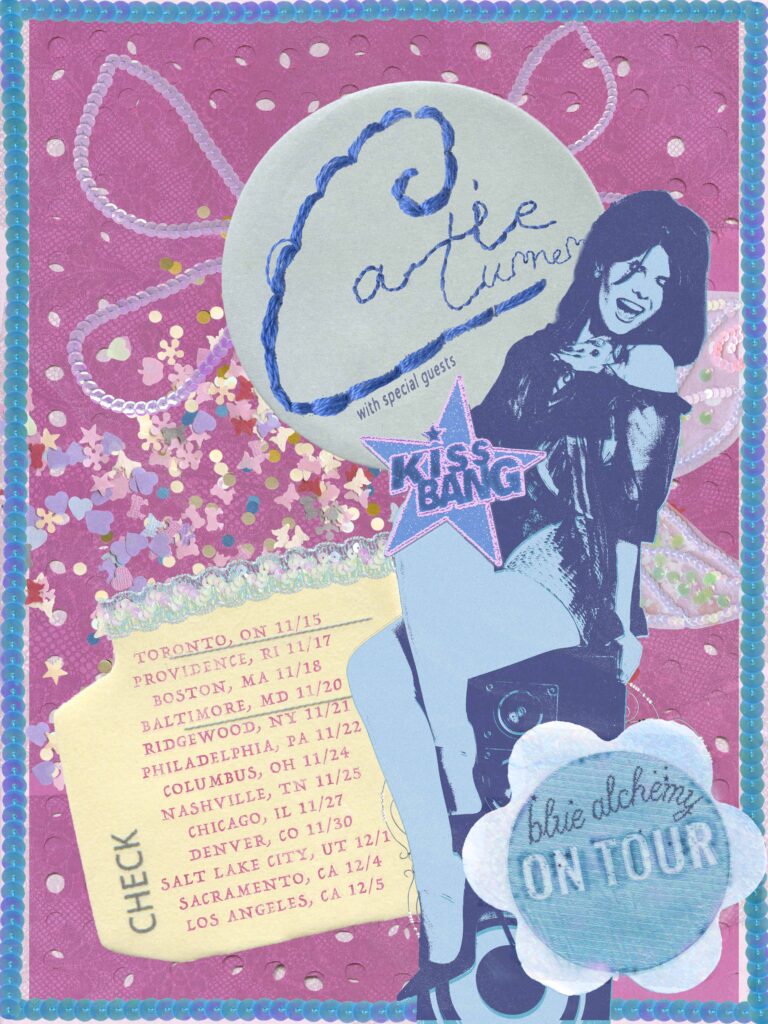
MM: You’re heading out on a fall tour supporting Blue Alchemy with Kiss Bang. Does putting a show together feel different now that you have an album to draw from, as opposed to just singles and EPs?
CT: Yeah, 100%. Especially putting together a tour independently, and leading the ship now, everything is completely different. I’m really trying to approach my career again from a place of fun. Putting together this show has been a series of wacky, ridiculous ideas that don’t get shut down, because I’m the one to shut them down, and it’s really awesome and nice to see what I can make of this universe now that this album is out, and now that I’m fully independent. I’m very excited. I think this tour is just endless possibility.
MM: Will the setlist consist mostly of new songs, or will you be doing a lot of your older singles, too?
CT: I’m gonna be doing a lot of my older singles. I put the set list together and I think it’s a perfect blend of songs everyone knows and the new stuff.
MM: You’ve opened for a lot of different artists, from Meghan Trainor to LÉON and Niall Horan. Is there anything you learned from watching the way those artists handled the show or interacted with an audience that you’ve incorporated into your own performances?
CT: I think you learn something from every artist you watch even if they’re like playing a 20-person room to a stadium. Everybody brings something different to the table. To watch people who have been doing it for so long do it, I think you subconsciously pick up on things. But I when I watched them, I wasn’t even thinking of what I could learn, I was just in awe of how they could command it. How self-assured they all seem. I just felt like a fan in those moments.
MM: Do you get more satisfaction from writing and recording, or from finally performing the songs in front of people?
CT: Oh, that’s such a hard question. I think maybe both for different reasons, really. Because writing and recording feels so personal to me, so I feel like it gives me that release on a personal level and it makes me feel complete as a person, but then being able to perform it and travel is fulfilling. So, they’re both fulfilling in different ways, and they both scratch a different itch in my brain, and I would say I love both of them equally.
MM: When you listen to music, do you prefer to listen to new music, or music that makes you feel nostalgic?
CT: Nostalgia all the way. I love listening to the music I listened to when I was 13, 14. Catfish and the Bottlemen is my favorite band of all time, so I find myself listening to their songs over and over and over again. It helps me feel more grounded, I think. It makes me remember a time where I just listened to music for the hell of it, because I loved it.
Special thanks to Catie for taking the time to speak with us and to Amanda Blide for setting it up.

Leave a Reply