
by Michael McCarthy
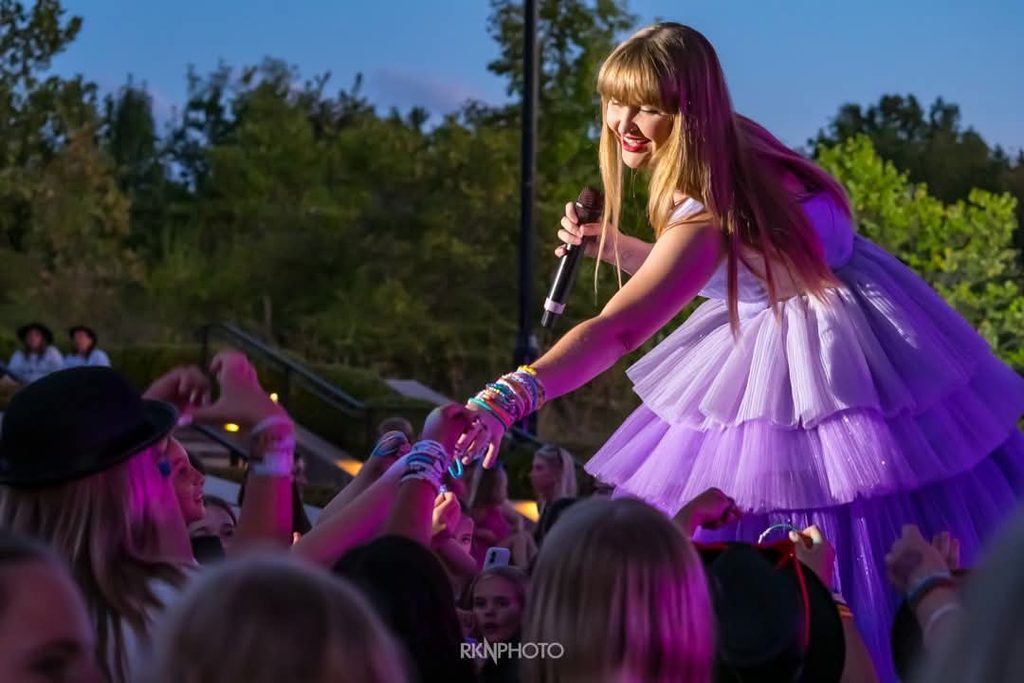
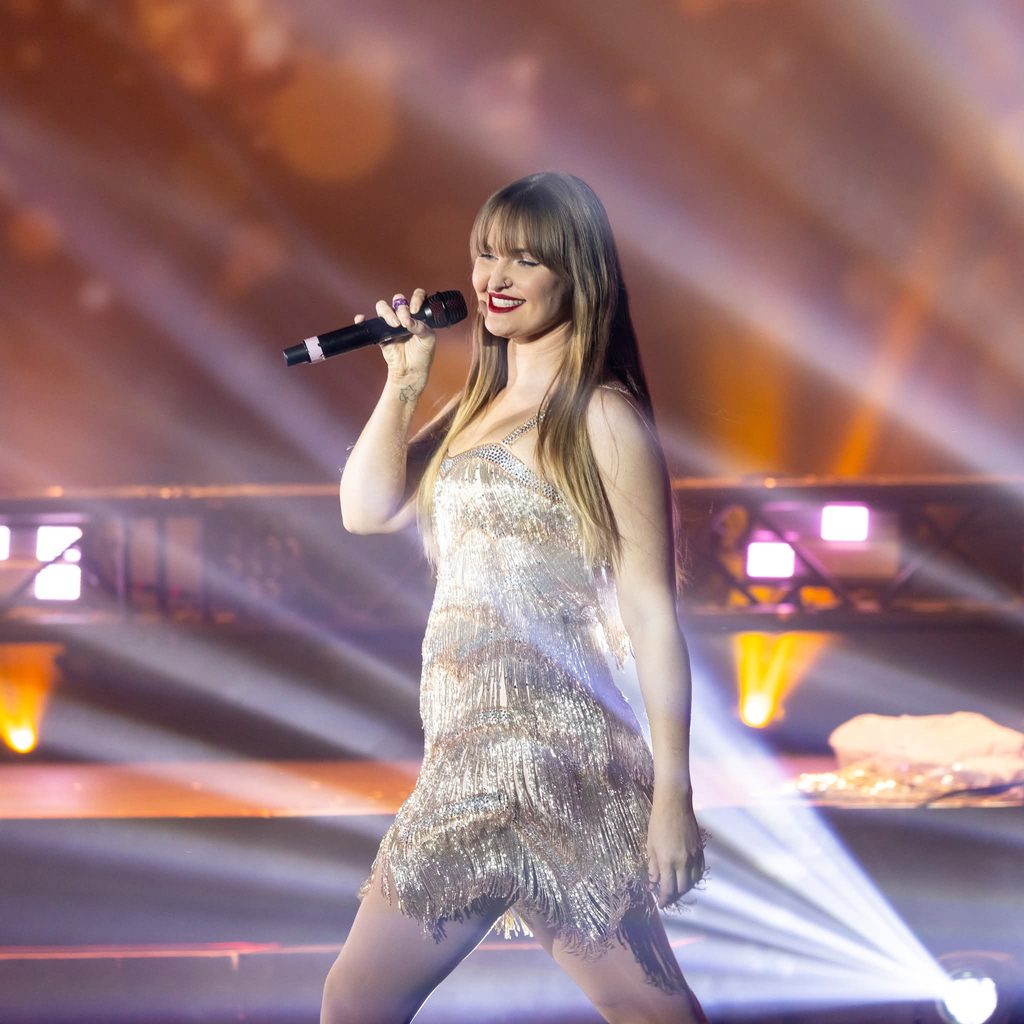
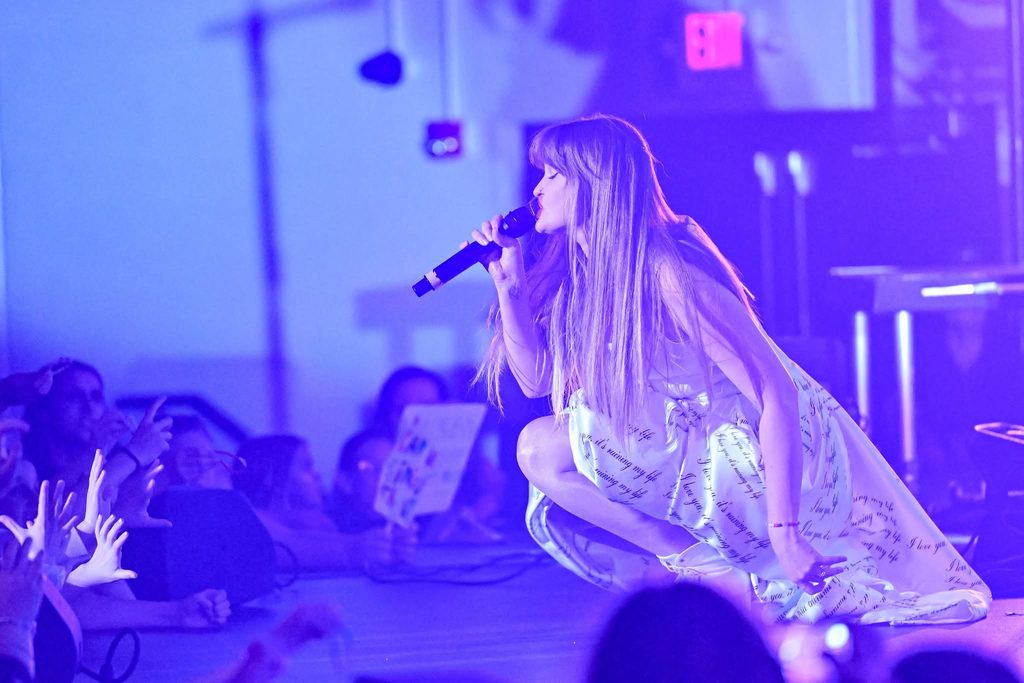
I recently caught the Taylor Swift tribute act Taylorville’s performance in Nashua, NH. As you can read in my review here on Love is Pop, I was very, very impressed. Frontwoman Sinead Angele did a fabulous job, sounding and looking as much like Taylor as you possibly could shy of actually being Taylor Swift. She was charismatic and a powerful singer as well and I think only Taylor Swift herself could actually change costumes as quickly and as often as she did at that show. And the band was fantastic, too, keeping the songs structurally and lyrically the same but also giving them something of a rock edge, complete with guitar solos for some songs. Naturally, I was curious about how this tribute act got their start and wanted to learn more about Sinead Angele, hence the following interview in which we discuss not only Taylorville but her excellent, original singer/songwriter music as well, which I would highly recommend to any fans of folk or folk pop music. Her EPs Self-Sabotage and Finally in particular are both excellent, as is her catchy recent single “Telephone.”
MM: First of all, you go by Sinead Angele, correct?
SA: Sinead Angele, that’s my first and middle name.
MM: Cool. I asked because I saw that you had a project called Liberata and I noticed on Spotify it had Fahey for your last name for that one.
SA: Yes, that’s my last name, but I just go by my first and middle now.
MM: I understand Taylorville was initially supposed to be a one-off performance. At what point did you get involved in the project?
SA: From the beginning. I think maybe the guys were trying to get a group together to do just one performance. A lot of the guys in the band, they either do high-end cover stuff or other tribute stuff they’ve dabbled with. So they wanted to do a Taylor Swift tribute, and I think there were maybe two people that had come in for an audition before me, but it just wasn’t gelling, and then I came in. So I’ve been there since the beginning.
MM: And how did you decide to take it on the road?
SA: Well, I think it was just demand. We had our first show, it sold out, added a second night, and that sold out too. And then we just got a couple of emails from, I think, a place in Illinois and then another place in a different part of Missouri. And with that, we just decided, hey, why don’t we just start reaching out to different theaters and amphitheaters and stuff and see what we can book? It started regionally and then it just grew from there.
MM: How many dates have you done this year, and how many more are coming up, roughly?
SA: Oof, I don’t know. I know we do an average of 50 to 60 a year, though, but I don’t keep count as it’s happening.
MM: Sure. What year did it start?
SA: 2023 was our first show, the very end of 2023, so 2024 was our first full year.
MM: How big of a Taylor Swift fan were you before you started performing her music?
SA: I would say I’m a pretty big fan. I don’t dive too deep into the world of the Easter eggs and the lore and all of that stuff, but I definitely know more than most other people I talk to on the street. But I’ve been a fan since her debut album.
MM: I understand that you actually named the band after an actual town, is that correct?
SA: Yeah, so we were driving to our first out-of-town show, or coming back from it, and our very first name was just, like, Swift, a Tribute to Taylor. And we’re like, we need a different name, we need something a little better, we need to maybe not have her actual last name in our name. And so we were driving back from Peoria, Illinois, and drove through Taylorville. We just saw the big sign and we’re like, ‘Hey, that looks good. Let’s try that out.’
MM: When you’re singing Taylor Swift songs, are you consciously trying to sound like her, or do you think your natural singing voice is already somewhat similar to hers?
SA: I think when we first started, I was definitely trying to sound more like her than myself. But I was also kind of recovering that first year from a nose surgery, so my voice in and of itself just wasn’t mine at that point. I think now, since I’ve been doing this for so long, my natural voice sounds a little bit closer to Taylor than what it had sounded like prior to this, just because I’m used to singing her stuff so much and trying to sound a bit more like her. But as my voice has gotten stronger–as my nose and everything got better–I’m starting to sound a bit more like myself as well.
MM: Now, when you were performing, I thought you very much kind of embodied the moves that she makes when she’s dancing on stage and everything. How much did you study her performances to learn her sort of persona like that?
SA: I watched the Eras Tour on Disney+ a lot and kind of just took from there.
MM: Where do you draw the line between singing her songs and being yourself? How much of what shines through on stage is you, and how much of it is you trying to act? Do you almost approach it like an acting role and not just singing?
SA: Yeah, I treat it more like a one-woman show, like musical theater. I would say it’s a nice blend. I don’t fully put myself into the role. There’s plenty of moments in the show where I’m doing something that I would do rather than what she would do, but I blend it just enough so that everyone in the audience feels like maybe it’s the essence of the Eras Tour, but also we’re all aware that it’s a tribute show. I’m not Taylor, I am a tribute artist, so it’s like a weird line. I’m not fully impersonating, you know what I mean? But it’s just enough to fit the vibe.
MM: The other night you were doing a meet and greet after the show. What is that like? Do the little, little kids think that you’re actually Taylor sometimes?
SA: Some of them. It really depends on what their moms tell them.
MM: There was actually a mom and a kid next to me at the show, and the mom was trying to explain that it was a tribute show, but the kid totally didn’t understand that.
SA: Yeah, it took my own kid about till five years old to kind of understand that I’m not actually Taylor Swift, so I get it.
MM: Were they disappointed when they figured that out?
SA: Maybe a little bit.
MM: Now, I understand you studied classical voice and jazz. Can you tell me about your background? I know you went to a few different universities.
SA: Yeah, so I was a chorus kid and did a little bit of musical theater in high school. So when it came to college, I figured I would just keep rolling with music and voice, and I thought classical would be a good place to get the foundational skills and good breath control, support, stamina, and all that stuff. So I got my associate’s in classical voice, transferred over to Towson University still as a classical voice major, but within a year, I was auditioning for the jazz department because I felt like it fit me better. And it wasn’t a department that my community college had, really, so it was a new opportunity. And it also gave me the ability to work on more commercial pop music as well. There are some overall foundational skills that apply to both, but for healthy belting, for example, all of my classical teachers discouraged belting entirely. They’re like, ‘No, it’s not good for you.’ But there’s a healthy way to do it, and I needed that training to do the kind of singing that I was gonna do after college.
MM: I listened to some of your original music on Spotify. I really liked it. Would you describe it as folk music?
SA: Thank you. I would say as of now, that seems to be the category that I fit into the most. It’s definitely very singer-songwriter-y. I’m influenced by a lot of indie pop. Ingrid Michaelson is a great example of stuff I grew up listening to. And Regina Spektor. I feel like that pops through sometimes, especially the Ingrid Michaelson. But yeah, as far as instrumentation and that kind of direction that I’ve taken, it definitely leans more folk. I think lyrically, maybe more pop singer-songwriter.
MM: Do you think you’ll ever do anything with your jazz background?
SA: Yeah, I kind of want to start some lounge duo gigs with my guitarist friend and get back into some crooning, you know? I sing my daughter lullabies every night and they’re always jazz standards.
MM: Who are some of your favorite jazz artists?
SA: Oh, man, Julie London and Ella. Always, always Ella. Billie Holiday, representing Baltimore, that’s where I’m from.
MM: One of the things that surprised me about your show was how much heavier some of the songs sounded compared to Taylor’s studio recordings. I mean, you even had some impressive guitar solos. Was giving the songs more of a rock sound a conscious decision, or did that just kind of happen?
SA: I think it happened naturally, because our guitarist, his bread and butter is more rock, especially pop-punk type stuff. So he definitely brings his own flair to it, and it also fits because if you look at the Eras Tour and you listen to some of her live versions of these songs, the drums hit heavier. They definitely make it more epic for some of these songs to build the energy up. So I think it works really well, and it also gives us a little fun twist, a little bit of a rock show on top of things.
MM: I was pleasantly surprised by how many songs you did that weren’t just the singles. How do you go about putting the set lists together? Is that difficult?
SA: No, we try to incorporate a lot of the hits, for sure, and then mostly pulled from the Eras Tour for some other ones. But as we’ve gone on, we’ve also included some deep cuts that we just really like. Like, we really love her song, “Better Than Revenge,” so that was in our cycle for a while. Right now, it’s almost the holiday season, so we’re doing “’tis the damn season,” from the evermore album, and it’s just a nice little holiday tune. So we switch it up a little bit, but it’s mostly just how we’re feeling, what songs we like the most at the time.
MM: The one thing I noticed was that when you did “willow,” the kids in the audience weren’t quite as enthusiastic during that one. They were hyper and really into things, and when that song came on, they kind of calmed down. Did you deliberately put that in there to kind of have a quieter moment in the set?
SA: I think with “willow,” it really depends on the audience. I mean, some places we’ve gone, that’s the song that they are looking forward to. I don’t know, sometimes it keeps the energy up, sometimes it doesn’t. We try to put just a couple of slower tunes or more mellow tunes in the first half, just for pacing. She has a lot of ballads, and I wish we could do more with her folklore and evermore albums, but it does, as you notice, change the energy a bit.
MM: Yeah, the song that I was thinking of, I didn’t think that you would actually do it, but one of my favorites that I think you would do well is “I Almost Do” from Red. Do you know that song?
SA: Yes. Yeah, I think it’d be cool, honestly, at some point to be able to do the entire Red album just front to back. I think that’d be fun.
MM: Yeah, I was wondering if you ever thought about doing a tour where you did one album like that.
SA: Yeah, we’ve thought about it. It’s just that there’s so many of her other hits that a lot of these kids want to hear. This next year, we’re gonna be doing a version of our show where we’re doing more Reputation and more Showgirl, and we’re calling it The Reputation of a Showgirl. So we’ll be deep diving more into those two specific albums, but we’ll still have some of the other stuff, like “22,” in it as well.
MM: Reputation is actually my favorite album of hers.
SA: Yeah, it’s so good.
MM: How many different costumes do you wear during a given show? Because I know you changed a lot.
SA: Probably about eight, nine-ish, depending on if you’re counting jackets or cloaks.
MM: Was it difficult changing costumes in between songs when you first started out?
SA: Absolutely. We had no idea what we were doing. I had never done more than one costume change in a show before, and now I was doing eight or nine. I work with Hannah backstage. She’s the one helping with all of the costume changes. And yeah, it took a lot of coordination with, like, how are we gonna pace the show? How are we gonna do transitions and interludes? And, you know, sometimes it’s still kind of like chaos backstage. Like, for that show that you were at, getting the red gloves on for the showgirl costume is always very difficult.
MM: You almost have to choreograph the way that you change costumes, I would think.
SA: Yes.
MM: Now, are any of your costumes actual replicas of things that Taylor has worn on stage, or are they more loosely inspired by what she wears?
SA: A lot of them at this point are replicas made by a cosplay designer in Vietnam, so they are very well made. They take a long time to get to us, so I have to really plan in advance if I’m gonna get another one. But they’re also not necessarily meant for as much wear and tear as we’re putting them through. But yeah, most of them are replicas of something from the Eras Tour at this point. Try to get as accurate as we can.
MM: I had never seen those bubble machines that made those bubbles that turned into smoke before your show. Whose idea was it to incorporate that, and what do they actually call those machines?
SA: I mean, we just call them bubble haze. I don’t know exactly what the proper name is, but I think it was our drummer’s idea to get them–his name is Jeff. It might have also been Brian, he’s our keys player. Those two are usually the guys coming up with new fun ideas to add to the production.
MM: Are there any special effects you haven’t used yet that you aspire to use in the future?
SA: I think lasers.
MM: That would be cool.
SA: So we’ve had the opportunity a couple of times to use stuff like cold sparks and pyro. We even had fake snow come from the ceiling one time, and that was really cool. But that type of stuff is so expensive, especially for us–we’re just a tribute band. It’s different if we were a full-budget, big-name act or something like that, so we’ve only had the privilege of doing that a couple of times. I would like to do that again.
MM: I was very impressed, though. It seemed like a very high-end, professional show, not just some kind of random thing you would come across.
SA: Thank you.
MM: Now, at the show I was at, there were a lot of kids. Do you get a lot of children at the shows, or do you get an older crowd sometimes?
SA: It’s mostly a lot of kids, a lot of girls and their moms, sometimes their dads, but lots of families. And every now and then, there have been a couple of shows where I would say it was more adult-centered than child-centered, but we’ve only ever done one show that’s 18 and over. Everything’s usually always family-friendly.
MM: Do you think that there’s fewer teenagers than kids because teenagers just think they’re too cool to go to a tribute show or something?
SA: I don’t know, it depends on the area. I mean, we do have quite a few teenagers that are very invested into our tribute. We’ve got a superfan, her name is Haley, she’s awesome, and another superfan named Lola, and those two have been to several shows. Like, Haley will travel hours to come to a show and she’s a teenager. So I’ll say the ones that we do have in our tribute fandom are like diehard fans. So that’s cool.
MM: How do you go about doing the meet and greets? Do you let the kids think that you’re actually Taylor if that’s what they already believe? Or do you constantly correct them and tell them that you’re not actually her?
SA: Just for legal purposes, if I’m being asked if I’m really her, I’m not gonna say I am, because I’m not. And it is very important just to make that distinction as a tribute band. We are just doing this because we really love Taylor’s music, and the audience really loves it, and we’re just sharing our love of her music together. I’ve had some people ask if I could sign my name as Taylor Swift, and I’m always like, ‘No, absolutely not. Can’t do that.’ But the very, very little kids, if they don’t directly ask me, but they’re just like, ‘I love you, Taylor. I love your albums,’ I’ll just be like, ‘That’s awesome. What’s your favorite?’ Like, you know, segue, because if they’re like four years old, yeah.
MM: Yeah, it’s kind of like how you don’t want to tell kids that Santa Claus isn’t real.
SA: Right. If they really believe and they’re that little, I mean, I think the older kids can totally handle it if their bubbles burst, but a little three-and-a-half-year-old, maybe not.
MM: Have you ever had any interaction with Taylor’s people or anything since you started?
SA: Yeah, so her management team definitely, within the first year, was sending out emails to not just us, but I guess all of the tributes, because the ones that I talked to said they got the same email. But basically, they gave us a disclaimer that we need to use. They told us we can’t use specific trademarked words or phrases. Like a lot of her album names are trademarked. Her name is trademarked. So we have to be very careful about what we’re putting on merchandise or how we are promoting the shows. Be very careful with the language around it, and we always have to be very, very, very on the strong side of ‘We are a tribute band, and we are not affiliated with them. This is fan-sponsored.’
MM: Do you know if they’ve actually ever taken legal action to try to stop any of the tributes?
SA: That I do not know.
MM: Have you put your original music on hold right now, or are you still writing songs?
SA: I’m constantly writing. I have three more songs that are gonna be coming out within the first half of 2027 that will finish up the EP I’ve been waterfall releasing. And I’ve already started writing for what will hopefully turn into my first album. But as far as performing everything live goes, that’s the tricky part with the original stuff, navigating the schedules around the tribute stuff. And then my band members are all in other projects, too, so just trying to get everyone together in one place is tricky.
MM: What instrument do you generally write songs on?
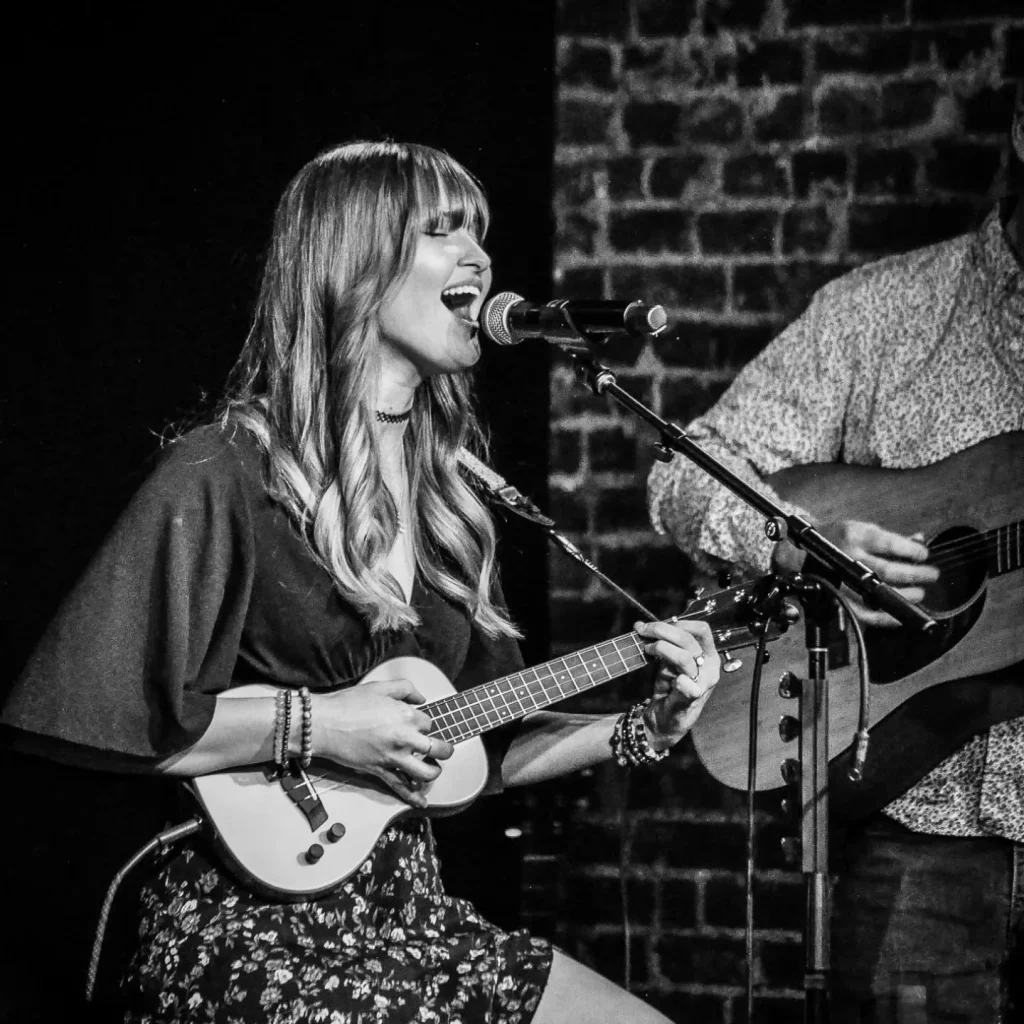
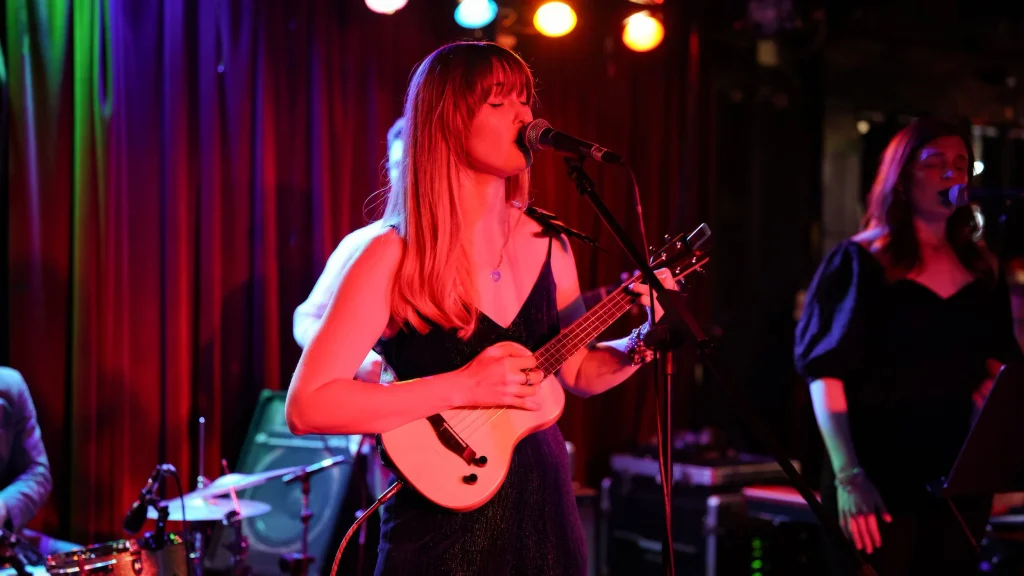
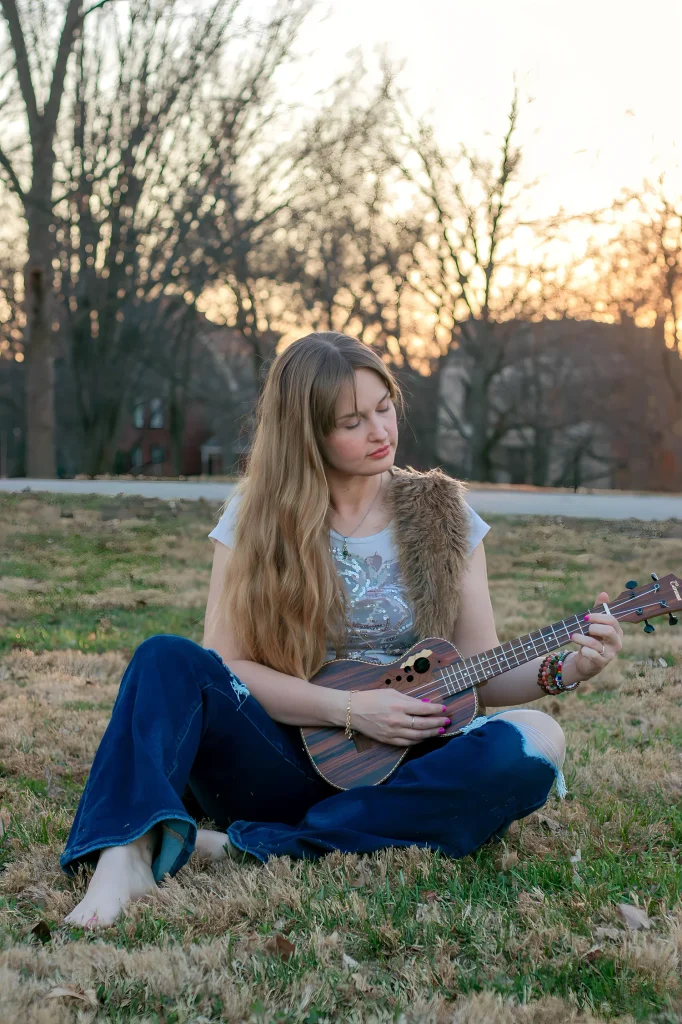
SA: Ukulele right now, but sometimes it’s piano.
MM: How long have you been playing the ukulele?
SA: I picked it up in 2020 during COVID.
MM: When you write songs, do you usually start with the lyrics or the music?
SA: It depends. I think the first line of a song will come to me with a melody and a lyrical line. And then I just sit down and I might pick up the ukulele, and then maybe it’s a chord progression that comes first, and then I add to it. But the melody and lyrics themselves always kind of come together. I’m never taking a poem or something and then adding a melody later.
MM: You released your first solo EP Finally in 2024. I understand that a lot of the material on the EP is about healing and overcoming anxiety. Did you find the process of making the EP therapeutic?
SA: I did. It was also a project for my culminating experience for Berklee. So alongside the EP, which was really therapeutic to write, I was also writing a research paper about how to organize an EP release from creation to production to the release strategy, from the perspective of someone with ADHD. So I was giving a lot of organizational tools and tips. So it was a really cool experience, not just emotionally, but also it’s kind of what helped me teach myself how to release music and then to continue to do that after the fact.
MM: You’ve said that your second EP, Self Sabotage, is more like a prequel than a sequel to Finally. What do you mean by that?
SA: Yeah, so Finally is the finding peace and healing EP. Self Sabotage was more, like, before the healing. I was taking a moment to reflect on some of my earlier self-sabotaging tendencies, mostly within love. “Hickory” and “Just Happened to Be There” are sister songs. “Hickory” is about limerence, and “Just Happened to Be There” was about an actual affair that nearly wrecked a relationship. And then the song “Self Sabotage” is a vague reflection of, why do I continually ruin things or sabotage things and repeat these patterns that I know are going to be harmful to myself or others? And maybe one day I’ll break out of it. And then “Life Is a Lesson” is a broader reflection of the last 15 or so years of my life and how far I’ve come and how I feel like, yes, I’ve sabotaged a lot, yes, I’ve made a lot of mistakes. But through all of that, I’ve learned so much, and I can’t trade it in for a different past because I wouldn’t be where I am now if I didn’t do all that crazy stuff.
MM: Has doing Taylorville increased your confidence and stuff a lot?
SA: Absolutely. Before the first show, I had never done a show like that before. I had done some musical theater. I had sung in choirs, but I had never fronted a band, especially a pop show in front of hundreds of people before–with lights and a video wall–and I didn’t know if I could do it until I did. So that has helped my confidence on stage significantly. When I first started, I would get nervous. I would shake before shows. I’d freak out a little bit. And now I just feel like I’m clocking in for work. I’m like, ‘All right, let’s do it.’
MM: Has doing her songs influenced your own songwriting when you write your original songs?
SA: I think she’s always influenced my songwriting. She’s got a really good knack for form, especially her verse, chorus, verse, chorus, bridge, double chorus type stuff. And just the way she’s very autobiographical and not afraid to give more descriptive or detailed peeks into her life in her writing. And I think that alone has inspired me so much to be a lot more vulnerable in my own writing and not to shy away from details or the messiness or the rawness of life.
MM: Sure. You said that “Take the Fall” was initially inspired by your feelings about the current political climate, but it eventually evolved into a song about a toxic relationship. Can you talk about how the song started and how you transitioned it into that?
SA: Yeah, so I’m not good at writing politically, but I do have a lot of very strong opinions about what’s going on. Around the time I first started writing it was when there was a lot of tension around ICE and how immigrants were being treated. And I myself was not born here–my dad is an immigrant–and I have a lot of very strong feelings. A lot of my family is not from this country or they’re first generation. And all of that was really hitting very close to home, and watching that was just horrific and making me feel really hopeless in this country. My entire life, I was told through school and through whatever that this is where people come to make their dreams come true. It’s the American dream, and it’s a melting pot, and it’s all this stuff, and here we are watching that being completely destroyed, and it was just really heartbreaking to watch. And then, like, just the president is so narcissistic. And just imagining if the relationship was the country and the president, right? You know, just how toxic that entire relationship is right now. And for me, I’m better at writing about relationships. I’m better at writing about love and breakups and all that kind of stuff. I guess that’s why it moved into that. But it’s the whole idea of ‘I’m not taking the fall.’ Like, you’re blaming me for things that are going wrong, but you know, you’re a problem, too. There’s a lot that comes out of his mouth that is blaming people in the country, whether it’s the Democrats, whether it’s the immigrants, whether it’s anybody that he doesn’t agree with is a criminal in his mind. And he’s just constantly pointing fingers and pointing blame and saying everyone else is the problem. And it was so frustrating. Like, look, I refuse to let you say that about me.
MM: Do you think that it might motivate you to write a more politically charged song?
SA: I hope so. I think I still have a writer’s block around that, because I’m so afraid to say the wrong thing or phrase it the wrong way. I feel like writing about relationships feels a little safer because it’s more personal, but when you’re expressing more heavy opinions, there’s a lot more that can be misunderstood or misconstrued or miscommunicated.
MM: There’s a song you should actually check out. You’ll probably laugh, but it’s by Bon Jovi, and it’s called “Blood in the Water” from the album 2020. And the whole song is about Trump, but he never mentions his name. It starts off saying “a storm is coming”, which is a reference to QAnon and all of that.
SA: Yes.
MM: So, every lyric in the song is somehow related to him and his administration from his first presidency, but he never actually comes right out and says that.
SA: Oh yeah, I’ll have to check that song out.
MM: So you might find it interesting.
SA: Let me take some notes on how to navigate that, use metaphors and stuff instead of outright saying things.
MM: Tell me about your more recent single, “Telephone”. What inspired that song?
SA: So I had just finished listening to the latest Noah Kahan album. And a lot of the songs were about, I guess, him coming back or people’s perspectives of him after he got famous and became successful and stuff. I started reflecting on how I felt over the past couple of years. Not like I’m this big celebrity or anything, but there are a lot of people in my hometown or in my life who knew me at some lower points. And I feel like it’s a weird thing to notice that people are there for you when you’re low. But then if you start getting your life together, and your mental health together, and you start finding more success in your career, or what have you–it’s a weird phenomenon that you’re gonna see some friends just kind of disappear, and it’s kind of confusing. You would think that they would want to be there for you at your best, too.
MM: Right.
SA: There’s a specific line in it, in the second verse, that’s actually a nod to one of my siblings, where I just feel like she never really wanted me to actually be successful, because in her mind it’s always been some weird competition between us, and I’ve never wanted to compete but I feel like that’s always how our relationship has been from her side. And so it’s a mix of talking about old friends and also some family members that, you know, just don’t put in any effort. Like, if I want to hear from them, or if I want to continue to have a relationship with them, I have to put in all of the effort on my side. And it just makes me feel like they don’t actually want anything to do with me anymore. And if I stop calling, I never hear from them again.
MM: Yeah, that’s how it is with me and a lot of my friends. I always have to be the one to call.
SA: Yes. It sucks.
MM: You’ve recorded a cover of Marcy Playground’s “Sex and Candy” with Jason Hamilton. How did that collaboration come about?
SA: Jason does a lot of different covers and stuff, and he was doing a cover series at first. We met through TikTok, and he just asked if I wanted to help him first with “Yellow.” And then we decided to do another one, and that was the “Sex and Candy” cover. And we’ve got a “Mr. Brightside” cover in the works if I will just sit down and record the vocals.
MM: Oh, I love The Killers.
SA: I know. I just have to do my job and just record it.
MM: I’ve seen The Killers something like 10 times.
SA: Yeah, they’re so good.
MM: We usually ask a few random questions at the end. Do you have time for that?
SA: I do.
MM: Cool. So, who are some of your favorite singer-songwriters?
SA: Currently or of all-time?
MM: I guess you could tell me both.
SA: I really do love, like I mentioned before, Ingrid Michaelson, Regina Spektor, obviously Taylor Swift. Jewel was probably one of my first singer-songwriters. I gotta give a nod to Jewel. And I would have to say, oh my goodness, I really, really gotta give it to Hayley Williams. And special shout-out to Natasha Bedingfield, too.
MM: If you could co-write a song with any artist, living or dead, who would you choose?
SA: Taylor Swift.
MM: Do you prefer listening to new music or music that makes you nostalgic?
SA: I like both. I mean, I’ll hyperfixate on maybe two or three current artists at a time whenever their newer albums come out. Currently, I’m obsessed with sombr. Just kind of stumbled upon his music recently. And Tove Lo has a new album out too. But I also love to revisit all of my favorite songs from the 2010s. That’s usually what I fold laundry to or play at the gym.
MM: When was the last time you went to a record store and what did you buy?
SA: I’ve never actually bought a record from a record store. I’ve been in them with friends, but I don’t own a record player, so I’ve never actually bought one.
MM: Do you buy CDs or any other format of music at all?
SA: Not anymore. I used to. I think the last CD I bought was–I don’t know, was it Switchfoot? It was like high school. It was a long time ago. Or maybe it was Relient K.
MM: What was the first concert you ever went to and who took you?
SA: It was a Christian artist named Rebecca St. James. And I was 12, and I went with my sister and our church group.
MM: What was the last concert you went to?
SA: Outside of local smaller ones, I’m trying to think. My last big one might have been Lake Street Dive. Yeah, that’s the last one.
Special thanks to Sinead Angele for taking the time to speak with us!
Read my review of Taylorville’s recent performance in Nashua, New Hampshire.

Leave a Reply