
by Michael McCarthy
Israeli singer-songwriter, composer, and multimedia artist Jasmin Stone has spent years creating music that defies easy categorization. In addition to releasing her own albums, she’s composed music for films, television, and theater, written songs for other performers, published poetry, and created imaginative music videos. Her influences range from Portishead and Saint Etienne to bossa nova, electronic music, and cinematic soundtracks. That diversity is reflected in her latest project, Broken Moon, a collection of atmospheric, dreamy songs that finds her embracing a warmer, more accessible sound than some of her earlier, more experimental work.
There’s something wonderfully hypnotic about Broken Moon. The music can be lush, romantic, and soothing, but there’s often something darker lurking beneath the surface. Songs like “Love Me Hurt Me” and “Faceless” explore subjects such as emotional vulnerability, loneliness, and the ways people can become disconnected from one another. And if you watch the accompanying music videos, you’ll discover that Stone has an extraordinary visual imagination. Her surreal worlds are filled with everything from colorful candy landscapes and eerie dolls to people with fish heads, butterflies, and other unusual objects where their faces should be.
What’s especially interesting is that Stone uses artificial intelligence to help bring these musical and visual creations to life. I know AI-generated art is controversial, and I understand many of the concerns surrounding it, particularly when it comes to copyright. But personally, I think there’s a meaningful difference between using AI as a creative tool and relying on it to do all the creative work for you. Stone’s approach strikes me as a thoughtful and responsible example of the former.
For starters, she isn’t simply typing a vague prompt into an AI music generator and asking it to write her a song. She begins with songs that she’s already written, arranged, performed, and partially produced herself. She then uses AI to reinterpret or enhance elements of those recordings, sometimes experimenting with AI-generated variations of her own voice. In other words, the songs originate with her, even if technology helps transform the finished recordings into something different from what she originally envisioned.
Her approach to music videos is similarly hands-on. Rather than asking AI to come up with a video for one of her songs, Stone develops the concepts herself, writes detailed scripts, plans individual scenes and visual effects, and uses carefully constructed prompts to generate the imagery she has in mind. She then assembles and edits the material using traditional video-editing software, sometimes incorporating live-action footage of herself. AI makes it possible for her to realize elaborate visual ideas that might otherwise require an enormous budget, but the artistic vision remains her own.
Of course, that doesn’t eliminate every ethical concern surrounding generative AI, particularly questions about the copyrighted material used to train some models. I asked Stone about those concerns, as well as exactly how she uses AI in her music and videos, and I appreciated her willingness to discuss the process openly.
But there’s much more to Jasmin Stone than artificial intelligence. During our extensive e-mail interview, we also discussed the inspirations and personal experiences behind Broken Moon, her love of Japanese pop culture, her work on a documentary about legendary Israeli singer Ofra Haza, and how a song she co-wrote eventually found its way into a DJ set opening for Madonna. She also spoke candidly about growing up and working in Israel, the emotional impact of recent events, and the challenges of pursuing an independent music career.
Whether you’re intrigued by her music, fascinated by the possibilities of AI, or simply interested in an artist who refuses to limit herself to a single medium, I think you’ll find Stone has plenty of interesting things to say.

Here’s the interview, which was conducted via e-mail:
MM: Your new project, Broken Moon, is characterized by a very atmospheric and cinematic sound. What inspired the creation of this album, and what did you hope to achieve musically?
JS: I have always connected with soundtracks (I write music for cinema and television), and also with bands whose music is cinematic or atmospheric (like Saint Etienne, Portishead, Stereolab, KOOP). This album had been brewing inside me for a long time, and I really wanted to create a world that is a bit ambient, a bit nostalgic, and a bit sexy. Compared to my previous albums, it is softer and even a bit caressing at times. It took time until I allowed myself to be this way; my previous works were more dramatic, sad, and angry. Now I say—it’s okay to smile, to be calm, to be pleasant, and that’s fine… 🙂 And most of the album is pretty much like that. So there is vocals here that aren’t dramatic, and a sound that was important to me to be full and alive. Compared to my previous albums, which were more experimental and art-focused in many ways, this is a sort of pop album.
MM: You described Broken Moon as a warmer and softer album than your earlier materials. Was this a conscious change of direction, or did the music simply evolve there naturally?
JS: Excellent question! Honestly, it’s a side that was always there, but I expressed it less. It came to light when I wrote for other singers (in Israel, I wrote for some well-known rock/pop artists), and I always knew it was a part of me. Over the past year, I took sketches and started testing different production directions, and I saw that this direction brought something else out of the songs—something with a new aesthetic, warmth, and flow. I realized I was embarking on a new and different musical adventure. But anyone who hears songs I wrote for other singers will recognize the connection to this album.
MM: The track “Demian” sounds like it could fit perfectly into a dance club. Were you aiming for that kind of atmosphere there? I found this track very hypnotic, like trance music. Was that one of your goals when creating it?
JS: The dance version of “Demian” was indeed intended for clubs. It is quite rare and will not be included in the official album, but only in special editions—because its vibe is truly more rigid and wild. The official album features the softer, more emotional-cinematic version, which nevertheless connects to the soft world of the album. But there is no doubt that this song is angry in essence; it is also autobiographical. It went through many transformations… It also has an old, completely wild version with operatic vocals. It’s a gothic cult song about a former lover who turns out to be a sort of “devil,” and the girl (in the song) feels restless; she wants him to confess his sins to close the circle. There will also be a music video showing this entire story.
Demian Album version: https://soundcloud.com/jasmin-even/demian
MM: What is the meaning of the name Broken Moon for you?
JS: Disappointment in love, in romantic illusions, which is something most of us go through… I wrote the song “Broken Moon” while experiencing this myself. I remember singing it once on stage while he was in the audience… It was a special night. It had a different, sadder melody back then. But later, I composed it anew, and the current melody is a lighter sort of bossa nova, which reminds us not to take anything too hard.
MM: The song “Faceless” explores how technology and social networks can leave people feeling lonely and disconnected. What inspired you to write this song?
JS: To tell the truth, the song was written at the height of the COVID-19 period. What is described in the song was very literal at the time: people walked around in masks, communicated via Zoom, couldn’t meet, couldn’t show their faces, and were trapped in their homes. But then COVID ended, and I said—hey, actually, everything stayed the same. We are still trapped in screens. We are still a mystery to one another, communicating through social networks and chats. The world lives through the internet; close contact is shrinking. I realized this song is beyond a COVID song. It is a parable.
MM: Have you personally experienced feelings of loneliness or disconnection as a result of social networks?
JS: Sometimes… it’s also a matter of personality… Someone who tends to isolate or disconnect will find that the digital world amplifies it even more—because it is a bit addictive. On the other hand, it can actually help—in my experience, for example, as someone who is sometimes shy or introverted, Facebook can be a platform that helps express yourself more clearly, so it has various sides. In conversations with friends, I realize it’s very easy to “fall” into the alternatives that the digital world offers to normal social life. Some people I know chat with Gemini… and so do I sometimes 😊
MM: Many people feel that social networks harm the mental health of teenagers in particular. Do you share these concerns?
JS: I completely agree with that. As an adult, you usually know how to manage what happens emotionally, keep things in perspective, and disconnect from the computer when necessary. But as a teenager, it’s very easy to get swept away into virtual life, into the illusion it can create, and to replace real friends with Gemini, who knows how to be the perfect friend. Not to mention destructive phenomena like teenagers shaming one another; it makes me sad that there is no supervision to prevent and stop these things. Maybe it would have been better to allow social networks only above a certain age…
MM: In the song “Love Me Hurt Me”, there is something almost seductive in the way you sing the words. It reminded me a bit of the song “Kiss with a Fist” by Florence + the Machine, which explores the connection between passion and pain. Are you exploring the same idea, or did you have something else in mind? Is the song based on personal experiences, observations, or is it a fictional story?
JS: First of all, it should be clarified that the song was co-written with Nathan Slor, who suggested the topic. For me, and in terms of my connection to the song, it’s a song that examines the world of casual encounters—a world that holds a strange mix of love and warmth alongside the coldness and cruelty of abandonment and alienation, which can sometimes hurt even if it isn’t openly admitted. I haven’t really experienced this in my life… I am quite conservative regarding my lifestyle. But I saw it around me, with friends, and with men I loved but didn’t get close to, once I understood their lifestyle. So even though I wasn’t active in the hookup scene, this topic fascinated me, saddened me, angered me, and attracted me at times. All together. What’s interesting is, that women who live this lifestyle describe it differently every time—some say that deep down they are sad, and others say they turned it into a means of gaining power. So it’s hard to fully understand. But it fascinates me. So it’s possible that if I sing seductively in the song, it’s a bit like stepping into that character.
MM: The song “Love Me Hurt Me” also reminds me of Lana Del Rey, especially her early material. Is she an influence for you at all?
JS: I love her very much. I’ve listened to her albums. I think my sources of influence in the context of this song are more AIR, Julee Cruise, Anita Lane, Portishead… But what I appreciate about Lana Del Rey is that she somehow made trip-hop and the David Lynch music style accessible to the current generation, and I feel she helped many good creators with that.
MM: I watched your music video for “Love Me Hurt Me”, and I noticed that the opening credits say “Created by Jasmin Stone and AI” (Artificial Intelligence). I thought it was interesting that you were so direct and transparent about using AI. Have you received negative reactions from people who oppose the use of AI in creative work? And can you tell us a bit about how you used AI to create the video?
JS: Yes, I think it’s important to be transparent; there is AI involvement both in the videos and in the music. Fortunately, I haven’t received negative reactions—maybe because anyone who knows and follows me knows that I have been a songwriter and producer for years. It’s not like I woke up this morning and said, “Hey, I feel like being a musician/video creator, let me press a button!” No, that’s not the story here 😊 So in this video, for example, I wrote the script completely on my own. Frame by frame. The effects too, and the vintage style. These artistic decisions were mine. The psychedelic “set” as well, with the bizarre backgrounds. It’s all written in prompts, scene after scene. In between, there are integrated still photos of me with all kinds of men ( imaginary men), which flash between the animation scenes. You barely catch them; only at the end do you see them clearly—it’s like the resolution of the image, showing what the song is actually about. I had to scan myself into AI to generate those still photos. Then I had to edit everything in old-school video editing software to the music. Like a primitive human:) . But it was important to me that this video be a personal creation. I wasn’t interested in pressing a button and having the AI generate something for me.
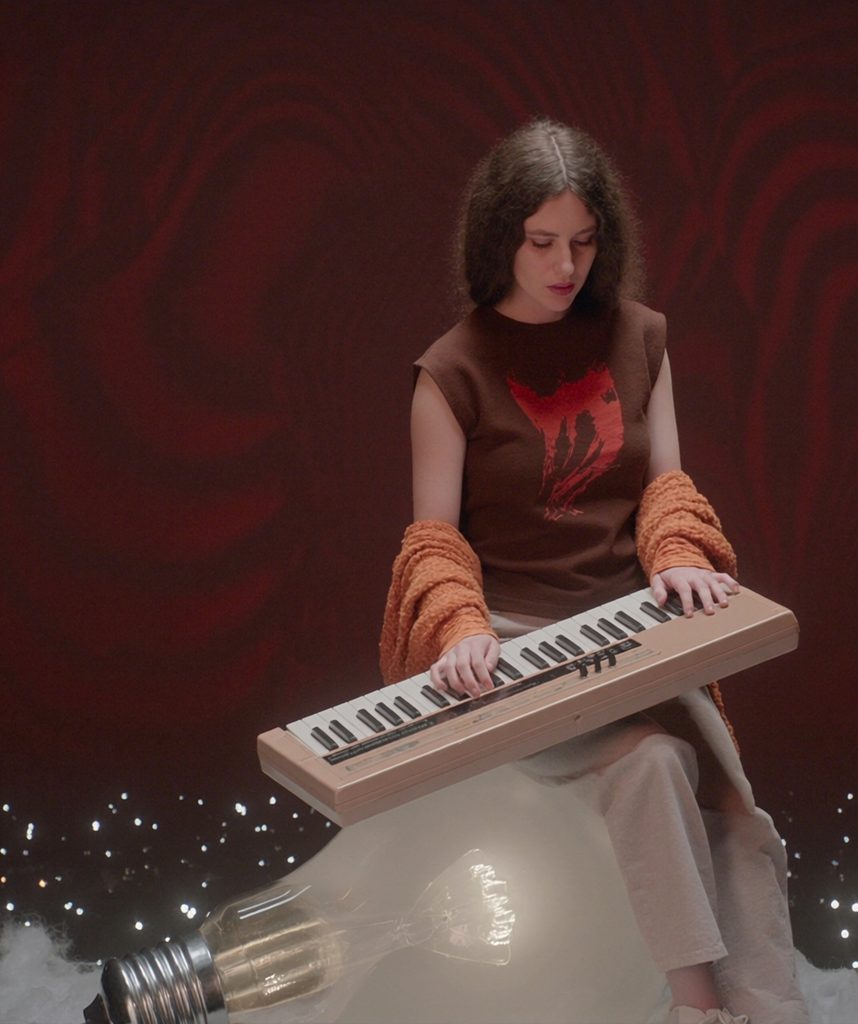
MM: In your video for “Love Me Hurt Me,” there is a fascinating combination of beautiful, colorful imagery alongside things that are almost disturbing, especially some of the dolls. What inspired this contrast?
JS: This contrast exists, in my view, in the real world of brief romances as well. It looks colorful, beautiful, sexy, seductive, and even happy. Clubs, dancing, beautiful, charismatic, smiling people. It’s the candy, the colors, the wings flying up, the amusement park with the horses calling you to ride them. But at a certain stage—a girl can feel that inside, she is petrifying. Her heart is turning to stone. She loses control, loses her head. Her heart dies. It was broken without her fully admitting it. She feels her body becoming a commodity, something to be used. Torn away from her. In the end, she wakes up one day feeling broken apart. And she wants to escape all of it. The story of this video was woven following confessions I heard throughout my life from women who went through this process. And their stories touched me.
MM: Do you want people watching the “Love Me Hurt Me” video to find it a bit scary? And do you think you could have executed such a complex visual concept without AI, considering how expensive traditional animation and special effects can be?
JS: I understand why there is something a bit Halloween-like about it—the severed heads, the dolls spinning headless, the bat wings. But through this, I tried to convey feelings of pain, of a soul being destroyed, and the supposedly scary imagery conveys what is happening inside, so I wanted the viewer to feel that disturbing element. By the way, regarding the second part of the question—there was another video for this song that almost came out. Maybe we will release it sometime. It is very beautiful visually, but it shows something that is more literal—clubs, provocative people, mystery, and darkness. Ultimately, I decided to make a new video with more imagery that speaks more about the feelings and less about the tangible thing. I don’t think I could have generated this video from scratch without AI; therefore, I think AI is a good thing. It encourages people to be creative and brings things out of them that would otherwise stay on paper. In the distant past, I studied classical and computer animation. But I didn’t end up working in it afterwards. Now, it’s a bit of a closing circle.
MM: One of the controversies surrounding generative AI is that some models were trained on copyrighted works without permission from the creators. Is this something you took into account when designing the videos? Do you have concerns about potential copyright issues surrounding AI-generated images?
JS: Excellent question. I try very hard in my prompts not to have copyright infringement. So I invent wild scenes and detail them, including the art style (Broken Moon, for example, is the 1950s). I use my own face when human characters are needed (all the characters, by the way, are somehow based on my face, with modifications). The dolls—I asked the AI to generate vintage dolls in a general way. I made the maximum effort so that there wouldn’t be scenes or characters that too closely resemble something else. Being original is also important to me.
MM: The part in the “Love Me Hurt Me” video where a doll spins around in a world made entirely of candy reminded me of a children’s board game we have in the United States called Candy Land. Do you have this game in Israel? And was it the inspiration for this part of your video, or did the idea come from somewhere else?
JS: I’m not familiar with it, maybe… I haven’t come across such a game, but it might exist in Israel. The idea of a candy land is an image of something that tempts you, but is actually destructive and unhealthy. I think the first time I encountered this imagery was in Pinocchio, when he arrives at Toyland (Land of Toys/Candy) and turns into a donkey there…
MM: I also really liked the video for “Faceless”. Could you tell us which specific AI tools you use to create your music videos?
JS: This video was made purely with Higgsfield, using a tool that allows control over camera angles. In other videos, I also used Firefly and the still-image generator “Soul”.
MM: Where did the idea come from for people to have fish heads in the “Faceless” video? Also, what is the underlying message you are trying to convey through your video and song?
JS: Essentially, the concept of Faceless is people whose essence is expressed through the alternative “head” that grew on them. So the community of fish-headed people looks for a sea to belong to, and they reach it, but then there is also someone who fishes them out and cooks them… which is like what happens sometimes in life to someone who looks to be a part of something and then discovers it’s a trap. The entire video deals with people’s essences being exposed—the man who fears commitment has a butterfly head, the woman who wants to get married has a house head, the greedy woman has a diamond head, etc. The human face is a mask that everyone puts back on themselves at the end of the video.
MM: I noticed there is a cat in both the “Love Me Hurt Me” video and in “Faceless”. Are you a big cat lover? Do you have any pets?
JS: In the upcoming video, “ECHO,” there is a cat as well. And in the video for “DON’T WORRY,” there will be one too (only the Broken Moon video has a peacock). I am absolutely a cat lover; I had a cat for 17 years, my aunt used to feed street cats, and in the past, I bought books with photos of cats of all breeds and kinds—even before it became a YouTube trend 😊 They are a gift to humanity.
MM: You also have a video for “Broken Moon”. Do you plan to create a video for every song on the Broken Moon EP (extended play)?
JS: That is absolutely the goal… The video for “Echo” will open for viewing at the end of October, the video for “Don’t Worry” is in the works, there is already a script for the “Demian” video… so I believe so, yes.
MM: You appear quite a bit in the “Broken Moon” video. How did you approach the task of combining live-action footage of yourself with the AI imagery?
JS: Editing the video and blending my scenes with the rest of the scenes was done in a video editing software that I have been working with for a long time. In terms of my appearance in the video, I tried to create a late-1950s look in terms of costumes and hairstyles. And I had to learn how to fly 😊
MM: Do you use AI while creating your music, or do you keep this tool mainly for video production? If you use AI for songwriting or production, in what aspects does it assist you—lyrics, melodies, arrangements, instruments, vocals, or mixing? And are all the voices we hear your vocal performances, or do you sometimes use AI-generated voices?
JS: That is an excellent question! This is how it worked on this album: I took existing songs of mine (lyrics, melody, arrangement, and performance by me) that were already partially produced, with loops, synthesizers, and all kinds of sounds, and I uploaded them to the AI. The AI passed the existing production through its filters: there are things it kept, and things it changed. Sometimes I also guided it stylistically. But ultimately, it maintained many of the roles that were in the original production. It also kept some of the sounds in certain songs; there were songs where it literally sampled my synthesizer and put it into its output. The process was fascinating to me. I really love everything related to progress and innovation. So basically, the AI was used for a sort of remake or remix of an existing production. Regarding the vocals: on most songs, the AI used a sample of my voice, and it often uses it in a way similar to me—in terms of pronunciation and intonation. Yet, the AI brings something additional and different to my voice and performance… and that’s what I wanted; I wanted to sound different from previous albums. There are one or two songs where I used a voice that the AI created inspired by my voice, and it is very close to it.
MM: Did you create songs without AI before all the AI tools common and popular today existed?
JS: Hmmm… hundreds of songs, and also instrumental pieces (meaning music for films,TV, plays, etc.). They are all registered with ACUM (the authors’ rights organization in Israel), so it can easily be proven 😊
MM: Some musicians fear that artificial intelligence could threaten human creativity, while others see it as a new artistic tool. How do you feel about these concerns?
JS: Many creators say this, also in the fields of cinema or visual arts. I admit that sometimes the thought of people who can now simply press a button and generate a finished song has something disturbing about it. You say—so now songs are like tap water, you open it and they flow. But—this is a given situation, and you cannot fight it, just as back in the day you couldn’t fight synthesizers that sometimes replaced musicians, or Photoshop that makes people look perfect. I don’t think we should stop progress. Human musicians, for example, need to reinvent themselves in ways that emphasize their difference from AI—the ability to perform live (with all due respect to holograms), the ability to identify emotional complexities when composing for cinema, and the ability to tell a personal and authentic story through music, which is something AI doesn’t have.
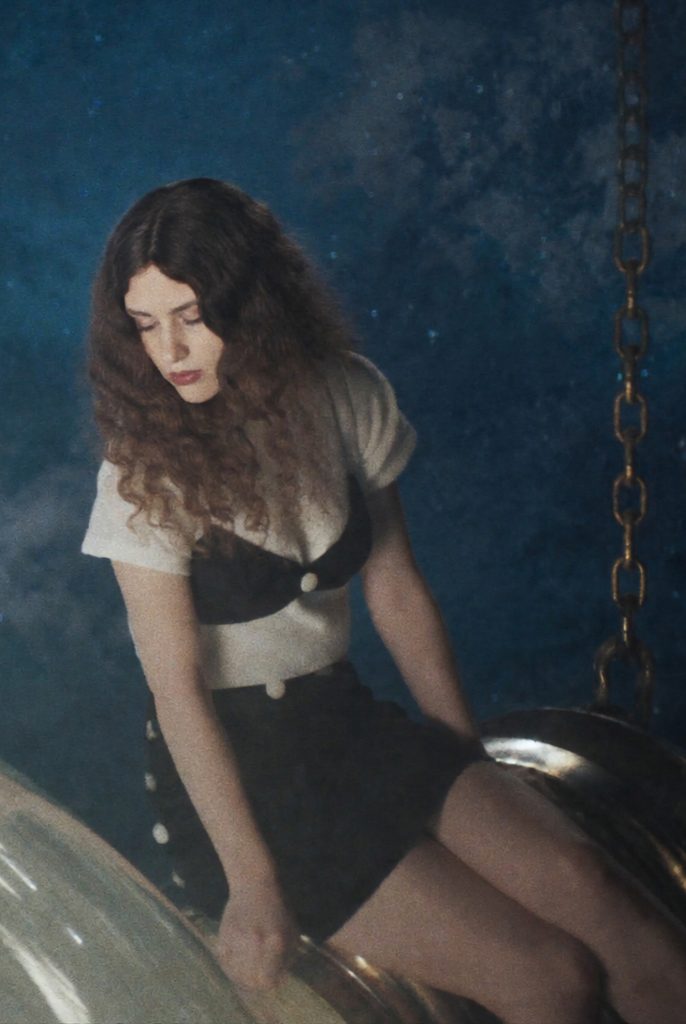
MM: Your music combines elements of dream pop, electronic music, and 80s synth-pop. Who are the artists that most influenced your sound?
JS: Wow. A very long list… If we focus specifically on this album—there is a bit of “The Human League,” a bit of “Smoke City,” a bit of “Saint Etienne,” a bit of “AIR” and Röyksopp, a tiny bit of Keren Ann, maybe also Beck, Depeche Mode, This Mortal Coil, Laurie Anderson, Enya, Pizzicato Five… on this album. In my previous albums, there were other, more dramatic influences, like Björk, Goldfrapp, Nick Cave, Diamanda Galás, and all kinds of progressive rock.
MM: Some of your songs have a quality that almost brings bossa nova to mind. In particular, the title track Broken Moon reminds me of the French band Nouvelle Vague, who merge bossa nova with new wave music. Have you ever been influenced by bossa nova or Brazilian music, or is it just a coincidence?
JS: I love bossa nova in all its forms. It’s a wonderful genre, and I have a special fondness for lounge bossa nova and electronic bossa novas, like those by Dimitri from Paris.
MM: Are you a fan of Nouvelle Vague by any chance? They have collaborated with many female singers over the years, and I truly think your voice could fit wonderfully with their music. Have you ever considered reaching out to them about a potential collaboration?
JS: I haven’t thought about it, but I like them very much and of course I would be happy to… I have recorded quite a few bossa songs over the years.
MM: Your music videos are very imaginative and sometimes surreal. How do you develop the visual concepts, and how closely are they connected to the songs themselves?
JS: I have loved surrealism since childhood. I think each video is inspired by the content of the song, but not literally. Just as in Faceless, the idea is connected to the song (lacking a face) but it’s also different from it—speaking more about people’s essences, social classes, hiding intentions, and more. It’s important to me to have mysterious, colorful, a bit bizarre elements, and somewhat psychedelic transitions. This mirrors the composition and musical language. It’s part of the visual language. Each video has its own world and characters. Love Me Hurt Me is a sweet, dark world of dolls and candy. Echo takes us to a world of ancient idols and primitive masks. In Broken Moon, people turn into cherries when they fall in love, and the cherries are a bit like the marimbas in the song—it correlates. The entire video, in terms of its design language, is a tribute to the “space age” genre —as is the arrangement of the song (the space age was an art/music language that was popular in the 1950’s-early 1970’s).
MM: You have composed music for films and television in addition to releasing your own albums. How has writing music for visual media influenced your approach to songwriting?
JS: Honestly, for me, it’s not very far apart… because the composition of my songs is often quite cinematic/theatrical as well. Quite a few of my songs have been described as “sounding like James Bond,” and that is a big compliment for me. There is something in my tracks, at least in some of them, that connects people to thriller or detective movies—the strings, the darkness. The two fields, composing for cinema and songwriting, grew within me simultaneously. In both, I also learned about collaborations and dialogue—in the cinema world, you maintain a dialogue with the director and a new musical language is formed out of the connection between you and the director, and you discover that you can create things you didn’t know you could. You experiment with new genres and realms. And it’s the same with writing for singers who came from a different musical background than yours, where you look for the connection with them, discover new sides of yourself through it, and stretch the boundaries of your creation.
MM: You composed the music for a documentary series about Ofra Haza. What was that experience like, and what did her music symbolize for you?
JS: Ofra Haza was a megastar in Israel; she was everywhere, she was a pop princess. I grew up on her, like many others. She sang sweet, innocent, optimistic songs (this was before she broke out globally with her danceable ethnic Yemenite pop). Nobody imagined how difficult her life’s journey was beneath the perfect smile and behind the golden voice. A pure-hearted and gentle woman for whom success became a sort of golden cage. She was very lonely, dreamed for years of finding love, and when it finally happened, it killed her—partly due to the great fear and shame of speaking about AIDS. It was the conservative society that indirectly caused Ofra to feel ashamed of AIDS, leading to her death as a result. I think she is a very important artist, one of the first to connect authentic world music with electronics, and one of Israel’s greatest representatives on the global music map. The series reviews her life story from a perspective of anger toward society, of a tragedy foretold, and tells of the pain and difficulty behind the success and glamour. This is a very powerful and moving 2020 series created by Dani Dothan and Dalia Mevorach, well-known documentary filmmakers in Israel who specialize in documenting Israeli music, and I work with them on almost all their films. I wrapped the series about Ofra in gothic music, perhaps a bit “cruel,” gloomy, played on synthesizers that have rigidity on one hand but also sadness and a caress on the other. By the way, during the work on the soundtrack, I got quite swept up by Ofra; I deeply researched her life, went over videos of her from various periods, and discovered or understood various things along the way—so they offered for me to appear in the series as a commentator, and I agreed 😊
MM: You also co-wrote a song for DJ Offer Nissim that was used by Madonna during her 2012 tour. How did this collaboration come about?
JS: It started in 2011—Nathan Slor and I wrote a song for the singer Josie Katz, who is a sort of rock-pop legend here—a kind of Israeli Marianne Faithfull (combined with Michelle Phillips). A guy named Tzach Orian, who is one of Offer Nissim’s artistic advisors, heard the song, got excited about it, and passed it on to Offer. To our delight, Offer loved it very much and decided to make a dark club remix for it. He loved the situation the song talks about—the sadness and loneliness after returning from a club. The connection between dance and sadness is a motif that appears a lot in his work. Exactly at that time, Madonna launched a new concert tour and decided that the world premiere would be in Israel, and that Offer Nissim would warm her up at this premiere (and at additional shows worldwide). Offer chose to include this track in the warm-up set for Madonna, which deeply, deeply thrilled us. This set also came out as a sort of bootleg, I saw later. This song, “After all the love is gone”, became a club hit, especially in South America. A few years later, we also wrote the song “Supernatural” for Offer Nissim’s album, which was named after the song: Supernatural.
MM: You have worked in several different creative fields, including music, poetry, and visual art. Do you find that working in one medium sparks ideas in another?
JS: Yes, of course! Just as a musical creation brings you ideas for a music video or for a single’s cover design—so too can a poetic text bring you an idea for a melody, or for a short poetry-film to accompany it. And if you make a poetry-film, you want to add a soundtrack to it… basically, it’s hard for me sometimes to make a clear separation between the mediums… perhaps, in fact, one doesn’t have to separate them. In Israel, composing poetry is a very common thing; in the past, it was even a real trend in the mainstream. So it feels natural to me to compose poems.
MM: Have you published any of your poetry? If so, has it been translated into English?
JS: I have published two poetry books, and quite a few poems in journals and anthologies. Few of them have been translated into English so far, and they were presented as poetry-films in festivals and exhibitions abroad. But two books is a small amount, it’s not enough…
MM: I read that you are particularly interested in Japanese pop culture, including J-pop. Has Japanese music or visual art influenced your creative work?
JS: Absolutely! I very, very much love the Japanese band Pizzicato Five; I have 5 of their albums (this is a band that served as a massive inspiration for the band Deee-Lite, by the way). So them, and also Fantastic Plastic Machine. Groups that mix clever electronics with retro and look with a wink at the Western pop of the past. And manga/anime comics—I consumed a lot as a child, and if I need to illustrate something, you can immediately feel their influence. Everything there is so aesthetic, magical, and precise. And there are other things that filtered into me from the Japanese world—Sega video games (I was a very heavy gamer). In one of the music videos I am currently working on, you will really feel their influence… And of course—sushi!!
MM: How does your experience growing up and working in Israel affect your music, if at all?
JS: I grew up in a country where childhood and youth are not simple; you experience difficult things from a very young age. I tried not to write about them; it was hard for me to cope as it was. The creation is usually the place I escape to; it is what protects me from everything that is happening. But in recent years, I could no longer hold myself back, and I wrote a few painful and bleeding texts about the war. I don’t think I will compose them; you cannot sing such words, only recite them. People I knew personally were murdered on October 7, 2023, including a talented and beautiful pair of musicians and peace activists who studied with me at “Rimon” (the music college). Musically, in my personal creation, you usually hear less of an Israeli sound influence. But when I write for other (Israeli) singers, or when I compose music for documentary films on topics related to Israel (like the films about Ofra Haza, David Grossman, and Menashe Kadishman)—suddenly this connection appears, and I surrender to it, remembering that these are actually my roots, that I grew up within this. Then, a synthesis is created between the “contemporary” identity and the Israeli musical world I grew up in. There is an amazing indie scene here in Israel. Unfortunately, there isn’t enough of an audience for indie or dream pop in Israel. It’s a small country. In terms of radio as well, indie artists are usually played only after ten at night or on niche stations. So in Israel, you do everything to exist as a musician—you compose for cinema, theater, and video art. Fortunately, from the very beginning, I wanted to be a film and theater composer, even before I started releasing my own albums, and I love this “scattering”.
MM: What would you like to explore next, whether musically or in your film and visual art projects?
JS: I hope to continue as I am now—to keep producing songs, videos, soundtracks for feature films (I hope to score films in USA), and poetry-films. I am working on the next album, part of which will be based on previous songs of mine translated into English, and part—completely new songs. Simultaneously, I am starting to write a musical. Hoping for the best!
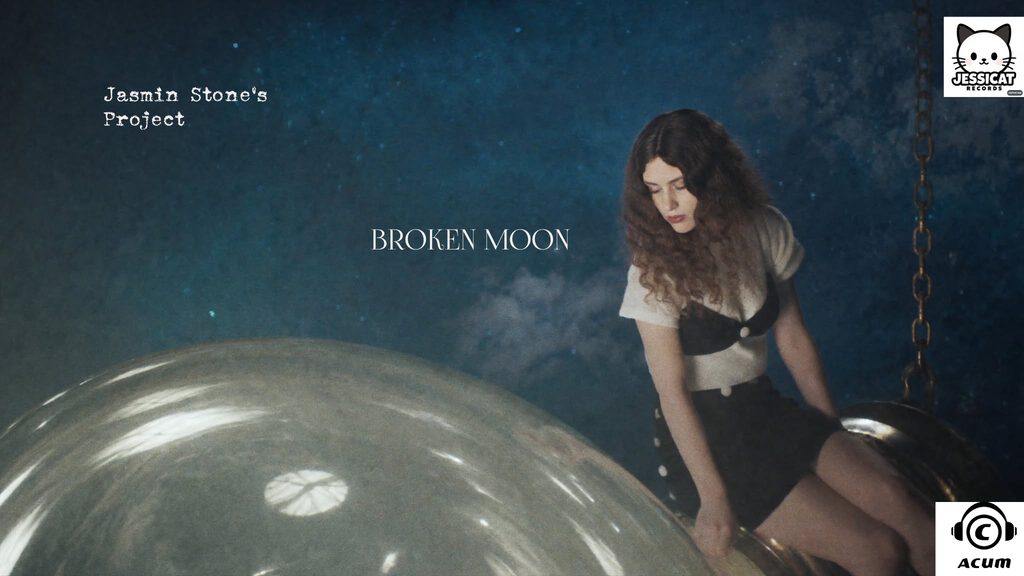
Special thanks to Jasmin Stone for taking the time to answer our questions and to Logan Kramer for arranging it.
Leave a Reply