
by Michael McCarthy
Montréal-based singer, songwriter, and producer SUUNCAAT makes some of the most intriguing and unconventional pop music I’ve heard lately. Her songs tend to be electronic, experimental, and filled with unexpected sounds, but they’re also catchy enough to get stuck in your head for days. While her music has been described as hyperpop, she prefers to think of it simply as pop music, albeit pop music that doesn’t necessarily follow anyone else’s rules.
Just as fascinating as the music are her videos, most of which she conceptualizes and directs herself. They’re filled with striking imagery, unusual characters, and symbolism that isn’t always immediately apparent. In the video for “work,” for example, she drags a mysterious figure wrapped in cloth, while “the wash” finds her exploring the strange, almost existential experience of doing laundry at a laundromat. There’s often much more going on in these videos than meets the eye.
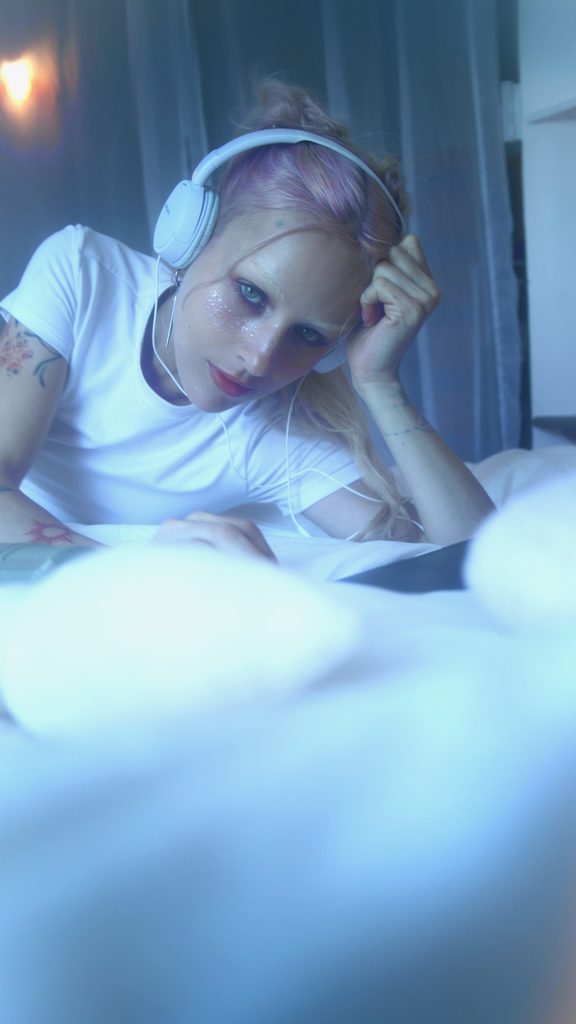
Having grown up in Brussels and spent time living in England before settling in Montréal, SUUNCAAT has an international perspective that’s reflected in her wide-ranging influences. She also has a background in classical music and a particular interest in creating immersive, cinematic soundscapes. Earlier this year, she made her live debut in Japan before performing at Pop Montréal in September.
I recently spoke with SUUNCAAT about her music, the stories behind her videos, her creative process, and her plans to release her first EP in 2027. We also discussed everything from Japanese audiences and Spotify to pet rats, philosophy, and autism awareness. As you’ll discover, she’s an artist who has a lot to say, and she’s not afraid to think outside the box.
MM: First of all, how do you pronounce SUUNCAAT? Am I saying it right? [EDITOR’S NOTE: I pronounced it like Sun-Cat.]
SUUNCAAT: You are saying it right, yeah.
MM: Okay, cool. I was curious, as a cat person, does it have anything to do with cats?
SUUNCAAT: No, it doesn’t really have anything to do with cat. I guess I had the idea for the name because of my fandom for Moondog. It’s kind of a nod to that.
MM: Your publicist describes your music as hyperpop, but I’ve also seen you describe it as metapop or simply as your own take on pop. Do you feel like hyperpop accurately describes what you do, or does that feel too limiting?
SUUNCAAT: I understand the importance of hyperpop as a subculture, but honestly, I feel like it’s also a way to segregate kind of modern pop music from the realm of pop music. So, I consider my music pop music because I guess pop is like the music of the people, if that makes sense.
MM: You’ve said that world building is one of the most important things to you. When you’re making a song, are you thinking about the world around it from the beginning, or does that develop after the music is recorded?
SUUNCAAT: Sometimes it comes from the music, sometimes it comes from the visual, but I guess they’re both already existent in my inner world, so I just spit them out and they take whatever shape they take.
MM: So, do you think about the visuals when you’re writing the songs?
SUUNCAAT: Yeah, it’s mostly a location that I think about with different symbols that are associated to it, just spontaneously.
MM: Do you normally write and produce all of your songs yourself, or do you have collaborators?
SUUNCAAT: I produce them myself. When I started the project three years ago, I was kind of co-producing a lot of the songs with my friend Jules in the basement, and it was just a way to, I guess, get validation for the music I had been doing for a long time, but nowadays it’s mostly by myself.
MM: Now, I noticed listening to your music with headphones today that it sounds a lot more lifelike and three-dimensional when you listen to it with headphones. Do you intend for it to be listened to that way?
SUUNCAAT: Yeah, I guess I come from an ambient background and a very cinematic style of music, and so I appreciate when you can really imagine yourself in a specific location, and so the panning, the stereo image is really important, I think, for the realism of it.
MM: When you write songs, do you usually hear something in your head first and then try to recreate it in the studio, or do you start off by tinkering around and experimenting and trying different things that way?
SUUNCAAT: So, it’s kind of a little bit of both. Melodies definitely happen. I’ll just dream of something, and it just drives you insane. It’s just very repetitive in your head, and you have to let it out, and they’re usually kind of earworms before they happen, but eventually you surely have to work on the arrangements.
MM: When you write, do you usually start with music or lyrics?
SUUNCAAT: Music.
MM: Do you have full creative control over your videos, or do you work with directors who contribute ideas as well?
SUUNCAAT: For the most part, it’s all by myself. I direct and conceptualize and do the set design and art direction completely, and then I will hire a director of photography, which is in reality more of a camera person. But for “evil,” I have worked with a director. She conceptualized everything, and we actually won a prize for it, but it had nothing to do with the conceptualization.
MM: What was the prize called?
SUUNCAAT: It was the Cour d’un Soir, which is a Montréal CISM organized festival for which we won the best artist for the music video.
MM: Now, how important is Montréal to your sound? Do you think your sound would be different if you were making music somewhere else?
SUUNCAAT: It’s a very internal thing, my music, but I guess I have kind of a love-hate relationship with Montréal in the sense that, you know, it has its industry with the great stuff that comes out of it, but also its problems like any city. I guess I have a relationship as a kind of an outsider person. I have a relationship towards Montréal, but if I was in another city, I feel like it would have been the same, honestly. It’s very internal.
MM: Have you always lived in Montréal?
SUUNCAAT: I grew up in Brussels, and then I moved to Montréal, but then as a teenager, I lived in Cambridge, UK, and then I came back, and then I did my undergrad in London.
MM: Just out of curiosity, do you speak French at all?
SUUNCAAT: Yeah, I speak French. I speak French and English. Mediocre at both.
MM: I’m very mediocre at French, so I won’t try it now, but I have been trying to learn. I actually went to Paris four times years ago.
SUUNCAAT: Oh, really?
MM: Yeah. So, I read that you grew up listening to everything from Tchaikovsky to Max Martin. I was curious, out of all of your different influences, is there one type of music that surprises people the most when they learn how important it is to you?
SUUNCAAT: I guess the one that surprises people the most would be like dancehall or reggaeton or just or bossa nova. I guess anything that comes out of the western culture as we know it.
MM: I’ve read that you’re a fan of Max Martin. What in particular that he has written or produced are your favorite songs of his?
SUUNCAAT: I don’t know if I said I was a fan of Max Martin, but I just considered him as one of the icons that would dominate talk for, you know, decades. And ultimately, he had such an influence on me and all of us, even though I never voluntarily listened to his music, it was always subliminally ingested.
MM: You started playing music very young, including violin and classical material. Do you think having a technical background made it easier for you to break rules and conventions later?
SUUNCAAT: I think it allowed me to break conventions, absolutely, because I think if you’re going to taste make or just create something new for the culture, it’s usually easier and more organic if you know the rules you’re breaking. And it just feels more intentional and honest that way, to me at least.
MM: You made your live debut in Japan this year. What was it like taking music that existed in the studio into a live setting?
SUUNCAAT: It made things very concrete for the first time, and it was kind of a surreal experience because I’ve always had such a deep affinity to Japanese culture, and I’m not a person who easily fits in here in America, and it was a lot of things [that] just came together. And both artistically and socially, it felt like a kind of reckoning of things. And so it was a very surreal moment, not only to get it out there, but to get it out there in front of people who relate to it.

MM: I know traditionally audiences in Japan would be extremely quiet when you’re performing and then clap at the end of a song. Is that how it is still today?
SUUNCAAT: Yeah, it is. It’s a very tame, highly conscientious crowd. They are very involved in the music and very focused on everything you’re doing. It’s very sweet.
MM: And where did you perform there?
SUUNCAAT: I performed at the Ruby Room in Shibuya on the first night, and in Cyclone on the last night, which interestingly, apparently is the first venue in Tokyo. We also performed in Nagano and in Kanji in a bar called The Roots.
MM: And have you performed outside of Japan as well?
SUUNCAAT: The only show I’ve ever performed outside of Japan was last week for Pop Montréal in Montréal.
MM: How did that go?
SUUNCAAT: It went really well. It was at Casa del Popolo. It was a completely packed room, and the crowd was really intense, comparatively to Japan. It was cool.
MM: And were there a lot of people there who already knew your music?
SUUNCAAT: I think it was mostly festival goers, and I guess a lot of people in Montréal kind of heard my music, but they were also going to the other bands [like] Friends and the Headliners, which is a really cool, weird, almost meme core band. It was very fun.
MM: Now, so far you’ve been releasing singles exclusively. Do you plan to release a full-length album at some point?
SUUNCAAT: We’re looking into conceptualizing my first EP this winter, so we’re going to get into production, and hopefully in 2027 my first EP should come out.

MM: Now I have questions that are kind of grouped together by songs after watching your videos yesterday. If somebody hears “the wash” as their first song that they hear by you and goes about exploring the rest of your music, what do you hope that they discover about you that isn’t obvious from this one track?
SUUNCAAT: Something that isn’t obvious from “the wash”?
MM: Yeah.
SUUNCAAT: Just that I have many different dimensions. “the wash” is kind of a silly concept and a silly song but I think artists should be able to have a completely different sound but also keep their sonic signature. I guess “the wash” is a very specific aesthetic, but I also have “bite,” which is completely different.
MM: You’ve described “the wash” as being about how ordinary routines can feel like a vortex through time because you keep doing the same thing even though you’re never quite the same person twice. Where did that idea come from?
SUUNCAAT: I don’t have a washing machine in my house, so I obviously end up spending a lot of time at the laundromat, and it happens every week or every couple weeks where I just stand there with all of these strangers and nobody interacts. It’s like this very private moment, and it’s also very intimate because you’re literally washing your dirty underwear, and we’re all going through very deep internal journeys, but when you just stand there and look around, it’s just people doing their laundry. There’s this sense of absurdity, and it’s always the same thing, and it’s never the same people, but it’s always the same people because it’s like NPCs [non-player characters] in the moment. I think about it a lot for some reason. I see an atrocious metaphysical weight to this mundane thing that laundry is.
MM: I actually tend to find doing laundry somewhat relaxing, although I just do it at home. Does it have a similar effect on you, or is it more like an annoying chore you hate having to do?
SUUNCAAT: No, I love it. I usually procrastinate it for three weeks, but once I’m there, I actually love it because, like I said, it’s a vortex. You get to go wherever, and you get to just stand there, but you’re actually doing work in your head.
MM: Is the laundromat in the video the one that you actually go to, or was it just a cool-looking location?
SUUNCAAT: Unfortunately, it’s a cooler-looking location. It’s in my neighborhood, though. I had been scouting it for a while because it really stands out with the teal color. So, we had done test shoots there, and I knew for a while I wanted to shoot there. We actually got kicked out when we shot.
MM: Oh, wow. So, you didn’t have permission then, I take it?
SUUNCAAT: No, they were impossible to reach, and I tried reaching them for two weeks. They wouldn’t answer, so we figured we’d do it raw. We shot for two hours, but then we got kicked out.
MM: Have you heard anything from them since you released it?
SUUNCAAT: No, I haven’t, and I don’t think I will. I legitimately tried to shout out
[to them] on Instagram to thank them for the location, but they’re just a non-existent entity.
MM: On the song, “work”, you sing, “I want you to work.” When you say that, do you mean that you want people to work or serve you, or are you talking in terms of wanting someone to be compatible with you who will work with you in a sense?
SUUNCAAT: I guess option B, but also I’m talking to myself in a way. It’s kind of an homage to perfectionism and how when you’re really hard on yourself, you’re also hard on the people you work with, but I think it’s an interesting question because it does tap into the fact that ultimately, I just want to be surrounded by people who relate to me and are kind of on the same wavelength.
MM: Now, some of your songs have lyrics that kind of repeat like mantras. Are these mantras that you say to yourself internally or were they just things you came up with when you were writing songs?
SUUNCAAT: I guess I really like repetition because I feel like the more you repeat something, the more real it becomes. I’m a fan of little, you know, curses and charms and things like that, and even nursery rhymes. I think they carry a lot of like cultural influence, and I’m just a fan of them.
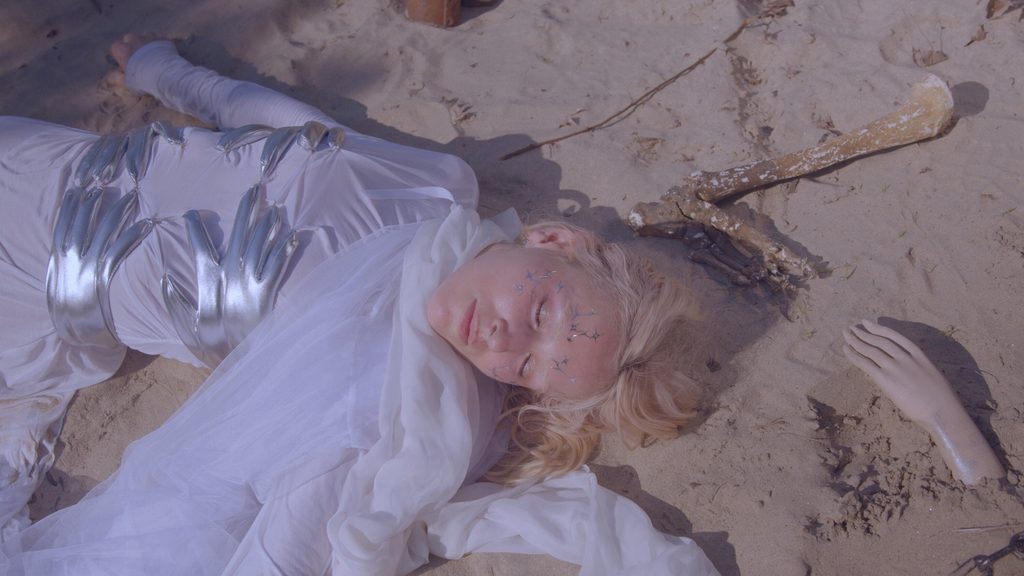
MM: I like the parts of the “work” video where you were dragging someone. What inspired that?
SUUNCAAT: It’s partially inspired by this book I’ve been reading, but also like by the mythology I’m trying to build for my world. The book is called There is No Antimemetics Division, and it’s about this world in which there are entities which cannot be named because the very act of naming them will make them disappear from your memory. They’re anti-memes, if you will. I was really inspired by that for the creation of that creature. So it’s just part of the lore. It’s a creature that basically will latch onto you. It’s invisible. The cloth around it is visible, but if you remove the cloth, it’s going to be invisible. And if you try to name it or conceive of it, then it’s going to eat your memory, if that makes sense. And it’s like a metaphor for, I guess, depression [and] mental ailments that kind of weigh us down.
MM: Were you dragging a real person in the video, or was it like a dummy or something?
SUUNCAAT: I was dragging my friend Jen, and it was 40 degrees outside.
MM: Oh, wow. Do you feel like you owe her now that she let you do that in the video?
SUUNCAAT: Well, we do a lot of things for each other, so I think we’re good.
MM: You get a bloody nose in the video. Was that meant to represent or mean anything in particular?
SUUNCAAT: I got a bloody nose because I worked so hard to my own detriment.
MM: I noticed in the “signs” video and some other videos that you often wear white in your videos. Is there a message behind that, and is it meant to represent innocence at all?
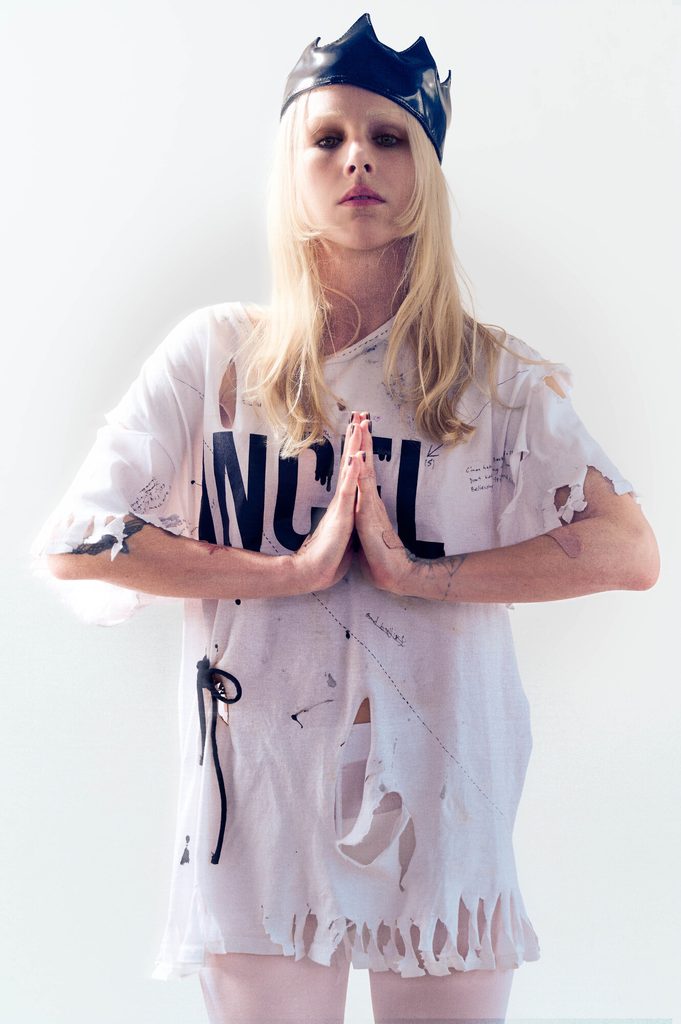
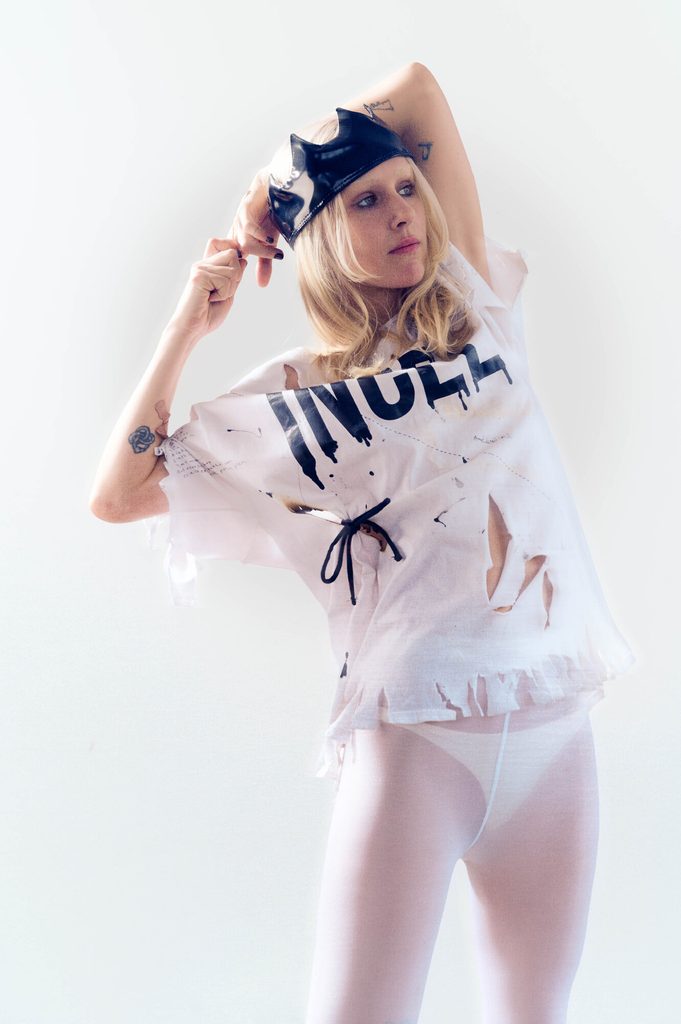
SUUNCAAT: Yeah, it’s meant to represent innocence, but it’s also meant to represent the opposite of innocence. It’s like what happens after the war and after the violence. It’s kind of just like purity and emptiness, but not necessarily in a bad way. So all of my characters will kind of wear white, but even the one that’s like the Inquisitress, for example, she wears white, but she’s not innocent anymore. I think white to me is like a way to maybe purify myself in ways.
MM: Now, you wear wings in the “signs” video, which I assumed were angel wings. Were you thinking of it that way?
SUUNCAAT: In that video, I was addressing the myth of the martyr. So the wings are kind of like the character post-martyrism.
MM: Somebody says something in what sounds like a foreign language at the end of “neighborhood.” What is that and what does it mean?
SUUNCAAT: That was my acting cinema mentor having a conversation with me, which I found really deep. And I started recording it. I don’t even remember what he’s saying, but I was making that song at that time. I just put it in there as a sample to kind of fill space.
MM: Are you pursuing acting as well as music then?
SUUNCAAT: A little bit, not as much as music, not actively pursuing it, but if there’s an interesting project, I will definitely be able to. I tried to make a feature film a few years ago, but the acting was really bad. So I kind of gave up on it.
MM: Do you think you might ever use that footage in music videos or anything?
SUUNCAAT: No, I’m not going to use the footage. I’m only going to use the knowledge I gained from shooting it.
MM: Is the person in red in the “signs” video meant to represent the devil?
SUUNCAAT: No, it’s not a devil. She’s not benevolent either. She’s a neutral yet chaotic character. She is a virus.
MM: Do you get into character when you’re making music videos, like imagining you’re playing roles like an actress, or do you just try to act like your natural self?
SUUNCAAT: It’s just parts of me, so I don’t have to act. That’s what’s cool about it.
MM: Oh, I noticed with “salad years” and some of your other videos that a lot of them are filmed largely outside. Is that coincidence or a deliberate thing?
SUUNCAAT: The light is better. It’s easier to control the light, and it’s cheaper too.
MM: In one of your videos, you’re holding a guitar, which surprised me because I don’t seem to hear guitars in your songs. Were you holding it ironically?
SUUNCAAT: No, there is guitar in my music. There’s a guitar solo in “salad years.” There’s guitar in my shows, too.
MM: Oh, okay. I must have had a brain fart when I was listening to it.
SUUNCAAT: It’s really highly processed.
MM: There’s a lot of footage that looks like it’s people’s home movies of their children in that video. What inspired that?
SUUNCAAT: Oh, that’s footage from my own childhood. I’m the kid in the videos. “salad years” is a song about nostalgia and letting go of the past. I used my own footage for everyone to see.
MM: Now, I have to ask regarding “pillz”. You sing, “I make deals, everybody wants my pills.” So, I was curious, is that autobiographical or were you writing that from the perspective of a character?
SUUNCAAT: No, it is autobiographical, but it’s also highly metaphorical. I’m not actually a drug dealer. It was just mostly about the weird thing that happens when you start having an influence on people. You go from being a weirdo that everybody makes fun of to someone who’s being copied. That’s kind of what the song is about.
MM: In the “evil” video, there’s a guy who looks like he’s in a bird’s nest. What is the meaning behind that?
SUUNCAAT: Marguerite Ranger is the director of the video and she came up with the whole narrative. And based on her narrative, I have a relationship with that bird and he cheated on me with another bird. Everyone’s a bird.
MM: I have to ask about the “bite” video. What was it like working with the rats?
SUUNCAAT: Oh, it was amazing. They were so sweet and they were very professional. They would shit on you a little bit, which is problematic when you’re wearing a white outfit, but they were so sweet. Except one of them kept running away for some reason.
MM: Have you ever had pet rats?
SUUNCAAT: I’ve never [had one]. I don’t know why. I always wanted one. They’re so intelligent, cuddly, and affectionate.
MM: Do you have any pets currently?
SUUNCAAT: I don’t. I am too busy. I wish. I love animals so much. I would really love to have two dogs, but since I live in an apartment, it’s kind of cruel, I think. I’m just not responsible enough yet.
MM: Some of the costumes in the “bite” video reminded me of some of the costumes Lady Gaga has worn over the years. Are you a fan of hers at all?
SUUNCAAT: I respect her and she wrote so many bangers, but I don’t consume her music actively.
MM: The song “Perfect” was a collaboration with Semiah. What was working together on that like?
SUUNCAAT: Oh, we really hit it off. I had never met Semiah. She was coming over to my friend Jules’ house because they had met over the internet and wanted to collab. Jules was like, hey, why don’t you just partake in the session? And so we all met at the same time and it was very easy and fun to work with. We came up with the song the same day and we finished it the same day.
MM: And did you make the video the same day or was that another project?
SUUNCAAT: That was another project. She came back to Montréal a few weeks after.
MM: Regarding the “luv 1” video, you’re covered in blood in quite a bit of the video. What do you imagine happened to the version of you in the video?
SUUNCAAT: I died in the car crash, unfortunately, after a party.

MM: Now at the end, I always usually ask a few random questions. What are your favorite books?
SUUNCAAT: Right now I’m reading The Broken Spears, which I really like. I like the sci-fi called Surface Detail by Iain M. Banks. I like the sci-fi called Wolfbane. And I like anything by Hegel.
MM: Do you have any favorite French authors by any chance?
SUUNCAAT: I would say the anthropologist René Girard is one of my favorite authors.
MM: What have you been watching lately?
SUUNCAAT: Actually, last night I watched Apocalypse Now. And then right after we watched the documentary, The Making of Apocalypse Now. And right before that–I don’t know why I’m in a Vietnam War phase–but right before that I had watched The Deer Hunter. It’s a phase I’m going through. I’m probably going to watch Platoon soon.
MM: Yeah, that’s a good one. What streaming services do you subscribe to or use the most?
SUUNCAAT: I have both Spotify and Apple Music, and I consume a lot of music on YouTube, although I don’t have an active membership. I think most of the music I consume is on YouTube. I do SoundCloud a lot, but mostly to connect with other artists.
MM: Now a lot of the artists I interview have been around for years and are used to having had careers where they would sell a lot of physical copies of their music, like CDs and vinyl. And a lot of them are very anti-Spotify, at least in terms of not feeling that Spotify pays people fairly. So I was curious, as a younger artist, what are your feelings about Spotify?
SUUNCAAT: Spotify is obviously the platform that pays artists the least of all the platforms, if I’m not wrong. But they also have many tools that they offer artists, and they do facilitate some artists’ careers in certain ways. So I think it’s a more nuanced discussion to have than just plainly saying Spotify is evil. We could all boycott Spotify, but I think there are other ways to do it.
MM: What are your all time favorite movies?
SUUNCAAT: I really like Ran and Dreams by Akira Kurosawa.
MM: Last question. Are there any social or political issues that you feel strongly about, whether it’s women’s reproductive rights, trans rights, or anything else?
SUUNCAAT: Obviously, women’s rights, freedom of speech, and autism awareness.
MM: I recently found out that I’m autistic, actually.
SUUNCAAT: Oh my God, really?
MM: Yeah. And I’ve been diagnosed as bipolar for years. Now I’m wondering if that diagnosis was even accurate, or if it was just autism, because I tend to get very loud and animated when I talk a lot, which they thought was a symptom of mania. But now I’m not so sure, so I have to look into that.
SUUNCAAT: It might be hyperfixation. It’s funny because, as a kid, I was also very intense, and they thought I had bipolar disorder, which I don’t. But I was diagnosed with Asperger’s.

Special thanks to SUUNCAAT for taking the time to speak with us and to Rachel Rossen for setting it up!
Leave a Reply