
by Michael McCarthy
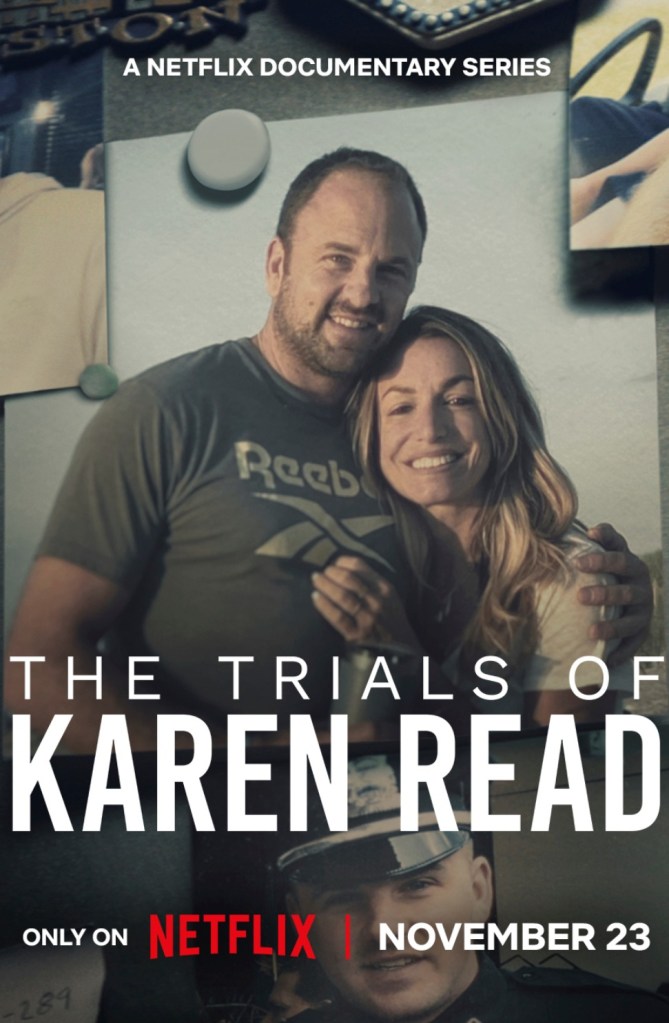
When I saw that Netflix had released another documentary about Karen Read, my initial reaction was something along the lines of, “Are you fucking kidding me? Another Karen Read documentary? For fuck’s sake, leave the poor woman alone!”
After all, we’d already had two highly publicized trials, countless news reports, endless social media arguments, and other documentaries about the case. What could another three-part series possibly tell us that we didn’t already know?
Well, as it turns out, quite a lot.
I started watching The Trials of Karen Read out of curiosity and ended up watching all three episodes back-to-back. And by the time it was over, I had completely reconsidered my opinion of Karen Read.
Let me explain.
For those unfamiliar with the case, Boston police officer John O’Keefe was found unresponsive in the snow outside a fellow police officer’s home in Canton, Massachusetts, on January 29, 2022. His girlfriend, Karen Read, was subsequently charged with killing him by striking him with her SUV and leaving him outside in freezing temperatures.
Read insisted that she was innocent, and her attorneys advanced an alternative explanation: that O’Keefe had been killed inside the house and that police officers and others had conspired to frame her.
The case attracted national attention, with supporters rallying around Read and demanding justice. Her first trial ended in a mistrial, but her second concluded on June 18, 2025, when she was acquitted of second-degree murder, manslaughter, and leaving the scene of a fatal collision. She was convicted only of operating under the influence.
I was one of the people who believed Karen Read was being framed.
I thought the police investigation was corrupt, and I found the defense’s allegations about a possible cover-up convincing. I also believed that Read had been treated terribly by a legal system that seemed determined to convict her.
But this new Netflix documentary made me question much of that.
One of the biggest issues involves Read’s broken taillight.
Read’s defense maintained that she had damaged her taillight when she backed into John O’Keefe’s parked vehicle while leaving his driveway to search for him on the morning he was found. Surveillance footage does show her SUV making contact with his vehicle.
But the documentary examines that footage closely, and a prosecution accident-reconstruction expert points out that there are no visible fragments of broken taillight on the snow after the collision. He also explains why the positioning of the vehicles makes it unlikely that such a minor impact could have shattered the taillight without causing considerably more damage.
Now, the absence of visible fragments doesn’t prove that the taillight wasn’t damaged there. But I found the expert’s explanation persuasive.
Then there’s the allegation that former Massachusetts State Police investigator Michael Proctor planted pieces of Read’s taillight at the scene where O’Keefe was found.
According to the documentary, there were only eight minutes between the last time Proctor was seen on surveillance video inside the Canton police station and the discovery of the first pieces of taillight by a state police search team. The drive between the two locations would have taken approximately four minutes.
Furthermore, there were numerous officers searching the scene, making it difficult to imagine how Proctor could have slipped in, planted evidence, and escaped everyone’s attention within such a narrow window.
Again, I’m not suggesting that the documentary proves evidence tampering was impossible. But it certainly made the particular scenario presented by Read’s defense seem considerably less plausible to me.
Another revelation that changed my opinion concerned Jennifer McCabe, the woman whose Google search about how long it takes someone to die in the cold became one of the most notorious pieces of evidence in the case.
Read’s supporters maintained that McCabe had searched for that information at approximately 2:27 a.m., hours before O’Keefe’s body was discovered. If true, that could have suggested she knew he was lying outside in the freezing cold long before anyone supposedly found him.
But McCabe always maintained that she conducted the search after O’Keefe was discovered, at Read’s request.
The documentary presents testimony from digital forensic experts explaining that the 2:27 a.m. timestamp was associated with a browser tab that had been opened earlier. The searches themselves were recorded at approximately 6:23 and 6:24 a.m.
The defense challenged that interpretation during the trials, but the forensic explanation presented in the documentary was persuasive to me. Something I had previously considered potentially damning evidence of a conspiracy suddenly looked very different.
And then there’s Aidan Kearney, the controversial blogger known as Turtleboy, who became one of the loudest voices in the Free Karen Read movement.
This is where things became especially disturbing for me.
For a long time, I believed Turtleboy was independently investigating the case and uncovering evidence that the authorities wanted to keep hidden.
But the documentary explores a much closer relationship between Kearney and Read than I had understood.
According to reporting based on recovered messages, Read initially communicated with Kearney through a woman named Natalie Wiweke, supplying information about witnesses and suggesting changes to his coverage. Eventually, the two began communicating directly.
That was a real shock to me.
Read and her defense team had publicly distanced themselves from Turtleboy, yet the messages indicate that they were much more involved with him than they acknowledged.
I found that deeply troubling, particularly because Kearney’s coverage helped fuel accusations against people who were never charged in O’Keefe’s death.
To be clear, communicating with a blogger doesn’t prove someone committed murder. Nor does promoting a questionable theory necessarily mean someone knows that theory is false.
But discovering the extent of these communications seriously damaged Read’s credibility in my eyes.
And one of the most powerful things about The Trials of Karen Read is that it gives some of the people accused of participating in the supposed conspiracy an opportunity to tell their stories.
Jennifer McCabe describes the harassment and threats she’s received, as well as the fear and anxiety that have become part of her everyday life.
Then there’s Colin Albert, a young man who became the subject of accusations that he’d fought with O’Keefe inside the house and possibly contributed to his death.
Photographs showing injuries to Colin’s knuckles were circulated as supposed evidence that he’d been in a fight. There were also videos of him making threats of violence when he was younger.
Colin testified that he’d injured his hand falling on an icy driveway weeks after O’Keefe’s death. He also maintained that he’d left the house before O’Keefe arrived that night, and text messages supported his account of being picked up around 12:10 a.m.
Watching him discuss the allegations and the impact they’ve had on his life was upsetting.
I had previously considered the possibility that Colin was involved in O’Keefe’s death. But hearing his explanation and seeing the evidence surrounding his whereabouts made me reconsider that assumption.
Of course, these are still people’s accounts of disputed events. But it’s one thing to read allegations about someone on social media and quite another to watch that person describe how those allegations have affected their life.
The documentary humanizes people who, for years, have often been portrayed as villains in an elaborate conspiracy.
And that raises a troubling question: What happens when the public decides someone is guilty of a terrible crime without sufficient evidence, then subjects them to years of harassment?
Even if Read herself never committed a crime against O’Keefe, that wouldn’t automatically justify the treatment of people accused of framing her.
Now, I want to make something very clear. My change of opinion about Karen Read does not mean I suddenly think the police handled this investigation properly.
Quite the opposite.
Michael Proctor’s deeply inappropriate text messages about Read were disgraceful, and I still believe the investigation deserved serious scrutiny. He was subsequently fired from the Massachusetts State Police.
I’m also troubled by the amount of drinking that took place that night and the fact that people were driving around during an approaching blizzard. Questions about drinking and driving, particularly among law enforcement personnel, deserve to be taken seriously.
And there’s still conflicting expert testimony about whether O’Keefe’s injuries were consistent with being struck by Read’s SUV. Defense experts presented findings that challenged the prosecution’s collision theory.
So I’m not suggesting that every question surrounding this case has been resolved. There were legitimate reasons for jurors to examine the evidence carefully, and Read’s acquittals remain the legal outcome of her criminal trial.
But I can tell you that, personally, I no longer believe the elaborate police conspiracy theory I once found convincing.
In fact, after watching this documentary, I’m now inclined to believe that Read may indeed have struck O’Keefe with her SUV. I’m even considering the possibility that she did so deliberately, perhaps impulsively during an alcohol-fueled argument. I can’t know what happened inside her mind that night, however, and the jury did not find her criminally responsible for his death.
That’s a dramatic change from what I believed before watching the series.
Perhaps the most important thing The Trials of Karen Read accomplishes is reminding viewers that John O’Keefe was a real person, not simply the victim at the center of a sensational true-crime mystery.
Through interviews with his family, including his brother and the niece he helped raise after her parents died, we get a much more personal understanding of the man whose death started this entire ordeal.
And that’s something that can get lost amid all the conspiracy theories, courtroom theatrics, and social media arguments.
John O’Keefe died tragically. His family lost someone they loved. Other people have endured years of accusations and harassment. And the public remains bitterly divided over what happened that night.
I went into this documentary wondering why Netflix thought we needed yet another series about Karen Read.
I finished it believing that this was one of the most worthwhile examinations of the case I’d seen.
It didn’t give me absolute certainty about what happened. But it challenged my assumptions, introduced me to perspectives I hadn’t adequately considered, and forced me to reassess evidence I’d previously accepted at face value.
That’s something the best documentaries should do: make us question what we think we know, even when the answers are uncomfortable.
I never expected The Trials of Karen Read to change my mind so dramatically.
But it did.
And I highly recommend watching it, regardless of which side you’ve taken in this controversial case.
Leave a Reply